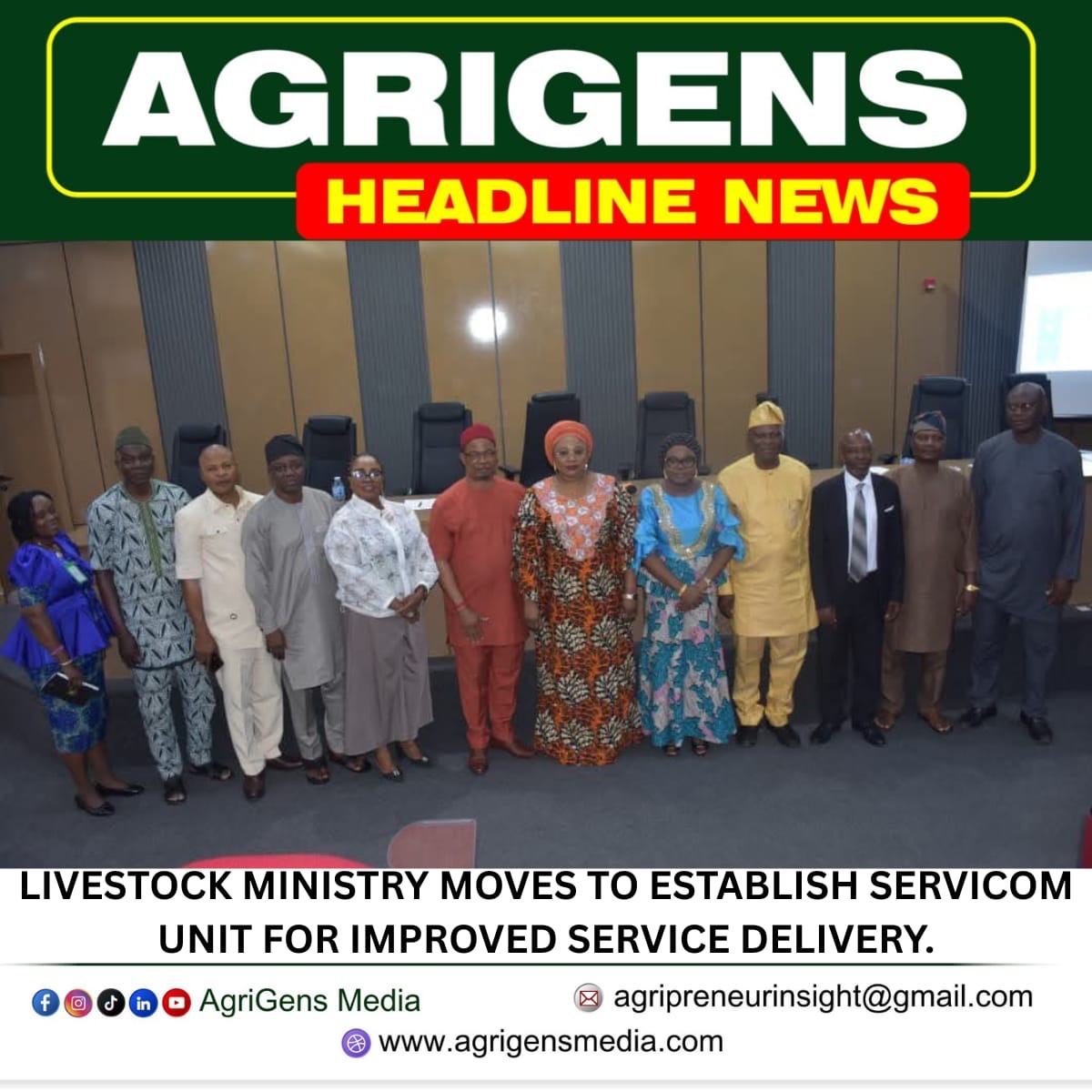
The Federal Ministry of Livestock Development has reaffirmed its commitment to improving service delivery, transparency and accountability through the establishment of a Ministerial SERVICOM Unit and the development of a Service Charter aimed at enhancing citizens’ access to quality public services.
The Permanent Secretary of the Ministry, Dr. Chinyere Ijeoma Akujobi, gave the assurance on Tuesday, June 9, 2026, while receiving a delegation from SERVICOM led by the Acting National Coordinator, Mrs. Helen Lawal, at the Ministry’s headquarters in Abuja.
Dr. Akujobi described the Ministry as a performance-driven institution with clearly defined goals and timelines, stressing the importance of effective monitoring and evaluation mechanisms to assess service delivery across Ministries, Departments and Agencies (MDAs).
She emphasized that accountability remains a critical component of efficient public service, noting that high-performing officers should be rewarded while underperformance should attract appropriate consequences.
“We are performance-driven and target-oriented. There should be incentives for those doing well and consequences for those who are not performing. Accountability remains critical to effective public service delivery,” she stated.
The Permanent Secretary also pledged the Ministry’s full support for SERVICOM activities and disclosed plans to create a dedicated budget line from 2027 to support the operations of the SERVICOM Unit.
Earlier, the Director of Reform Coordination and Service Improvement, Eto-Abasi Okokon, welcomed the delegation and noted that despite being one of Nigeria’s newest ministries, the Federal Ministry of Livestock Development had recorded notable achievements in service delivery under the leadership of the Honourable Minister of Livestock Development, Idi Mukhtar Maiha and the Permanent Secretary.
In her presentation, the Acting National Coordinator of SERVICOM, Mrs. Helen Lawal, commended the Ministry’s management for its commitment to institutionalising the Federal Government’s service delivery reforms.
She explained that SERVICOM was established to promote excellence in public service delivery and ensure that citizens receive quality, timely and customer-focused services from government institutions.
Lawal outlined key areas of collaboration between SERVICOM and the Ministry, including the establishment and inauguration of a Ministerial SERVICOM Unit and Committee, staff sensitisation on SERVICOM principles, development of a Service Charter, capacity building programmes, customer satisfaction surveys, complaints management and participation in quarterly Charter Performance Sessions.
According to her, the Service Charter will serve as a strategic accountability tool by clearly outlining the Ministry’s services, standards and timelines, thereby enabling citizens to hold service providers accountable.
She further called for sustained management support, adequate staffing, regular training and continuous stakeholder engagement to ensure the successful implementation of service delivery initiatives across the Ministry.
In his closing remarks, the Director of Planning, Research and Statistics, Mr. Stephen Ohaeri, expressed appreciation to the SERVICOM delegation for the productive engagement and assured them of the Ministry’s commitment to implementing recommendations that will enhance service delivery and improve customer satisfaction.
The meeting underscored the Ministry’s resolve to institutionalise best practices in public service delivery and strengthen citizens’ confidence in government services.