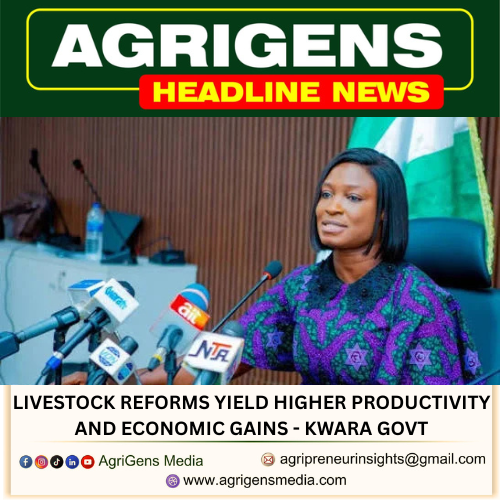
The Kwara State Government says its ongoing livestock reforms are improving productivity and creating greater economic opportunities for farmers and pastoralists through interventions targeting key areas of the livestock value chain.
The Commissioner for Livestock Development, Oloruntoyosi Thomas, disclosed this while reviewing the achievements of Governor AbdulRahman AbdulRasaq’s administration in the livestock sector.
Thomas said the government’s broader objective was to transform livestock production from a largely subsistence activity into a commercially driven industry capable of creating jobs, improving food availability and increasing household incomes in rural communities.
She disclosed that average annual milk production per cow increased from 274.5 litres at the beginning of the intervention to 352.2 litres in 2025, representing a 28.3 per cent improvement.
She also reported significant gains in meat production, with the average carcass weight of cattle rising from 135kg to 190.8kg, while that of sheep increased from 14.2kg to 23.7kg.
The commissioner attributed the improvements to better animal health services, farmer capacity building, infrastructure development, pasture interventions and efforts to make livestock production more commercially viable.
She said the state had intensified disease prevention measures, leading to the vaccination of 238,718 animals, including cattle, sheep, goats and poultry, with more than 1,100 livestock farmers benefiting from the exercise.
Thomas said that since the Livestock Productivity and Resilience Support Project (L-PRES) commenced in October 2023, the government had profiled 8,951 individuals operating across selected livestock value chains, while about 100 meetings and stakeholder engagements had been conducted.
She said veterinary services had also been strengthened through the rehabilitation and equipping of the veterinary laboratory in Ilorin and the improvement of the vaccine cold-chain system with solar power.
According to her, the interventions increased the number of animals screened at the laboratory from 157 to 246.
Beyond veterinary services, Thomas said the government had invested in facilities aimed at improving the efficiency and sustainability of livestock production, including solar-powered boreholes, livestock drinking troughs, cattle sheds, feedlots and elevated goat pens.
She said 10 integrated ruminant farming clusters had also been established, featuring water facilities, animal housing, cattle dips, solar lighting and pasture demonstration areas.
According to the commissioner, the clusters were designed to provide livestock producers with improved operating conditions while encouraging better animal husbandry practices.
She added that 1,509 livestock farmers had received training in areas including small ruminant production, the use of crop residues, commercial fodder production and bull fattening.
Thomas stressed that improving productivity required more than physical infrastructure, noting that farmers also needed access to knowledge, technical assistance and modern production techniques.
On climate resilience, she said about 34 per cent of targeted farmers had adopted climate-smart technologies.
She added that Automatic Weather Stations had been installed in collaboration with the Nigerian Meteorological Agency and Michigan State University to provide farmers with more localized weather information.
The data generated from the stations, she said, would assist farmers and authorities in preparing for drought, managing pasture and water resources and making informed livestock production decisions.
Despite the progress recorded, Thomas acknowledged that farmer-herder conflicts, limited access to veterinary and extension services among women, weak artificial insemination and breeding systems, inadequate pasture production and poor maintenance of infrastructure remained challenges to the sector.
She therefore called for greater private-sector participation in the livestock economy, particularly in livestock marketing, feed processing and cold-chain facilities.
Thomas said government alone could not provide the investment required to fully develop the industry, stressing that private capital would be critical to unlocking opportunities across the livestock value chain.
She said the administration would sustain efforts to expand pasture and fodder production, improve animal health and breeding services and strengthen the maintenance of livestock facilities.
The commissioner added that the government would intensify efforts to increase the participation of women and young people in the livestock economy while creating an enabling environment to attract greater private investment.