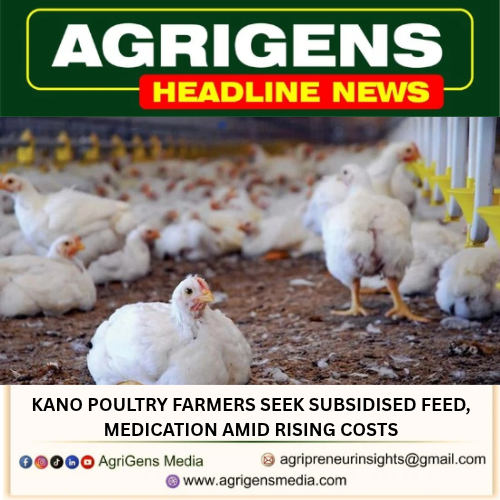
Poultry farmers in Kano State have called on the government to provide subsidized feed and medication to reduce production costs and sustain their businesses amid rising prices of essential inputs.
The farmers made the appeal in separate interviews with journalists on Tuesday, 20th of October 2026 in Kano, expressing concern that increasing expenses were squeezing profit margins and making poultry farming more difficult to sustain.
One of the farmers, Aminu Nabegu, said poultry feed prices had risen significantly, citing the increase in a bag of Ultima Plus from N20,000 to N23,000 and Ultima feed from N18,000 to N21,000.
He added that Chikun feed had increased from N16,500 to N18,000, while Hybrid feed rose from N12,000 to N14,200. According to him, day-old chicks that previously sold for between N500 and N700 now cost about N2,000, further increasing the capital required to establish and operate poultry farms.
Nabegu said farmers could still make some profit by selling mature birds at higher prices, but the substantial cost of starting a poultry business had discouraged prospective entrants. He added that poultry farming remained his primary source of livelihood despite the financial challenges.
He also identified the approaching harmattan season as an additional concern, noting that farmers needed electric bulbs or lanterns to provide adequate lighting and warmth for their birds. He explained that proper lighting helped birds locate feed and water at night, while sufficient warmth supported their health and growth.
Nabegu urged the government to prioritize experienced poultry farmers in its support programmes, arguing that they had the knowledge to utilize assistance effectively. He estimated that raising 100 day-old chicks to market size could require between 13 and 14 bags of feed, depending on feeding practices and farm management.
Another farmer, Ruth Johnson, said her interest in poultry farming stemmed from her passion for keeping birds, which she regarded as a hobby. However, she noted that the cost of running her farm had increased considerably compared with the previous year, particularly spending on chicks, feed and medication.
Similarly, Amos Patrick said rising production costs had not discouraged him from poultry farming, although he had become more cautious with his resources. He explained that he fed his birds according to the funds available and sold them based on customers’ needs, with some preferring five-week-old birds and others requesting birds aged six to eight weeks.
The farmers urged the government to introduce measures to make poultry feed, medication and other essential inputs more affordable, saying such interventions would ease financial pressure, support business sustainability and help farmers remain in operation.