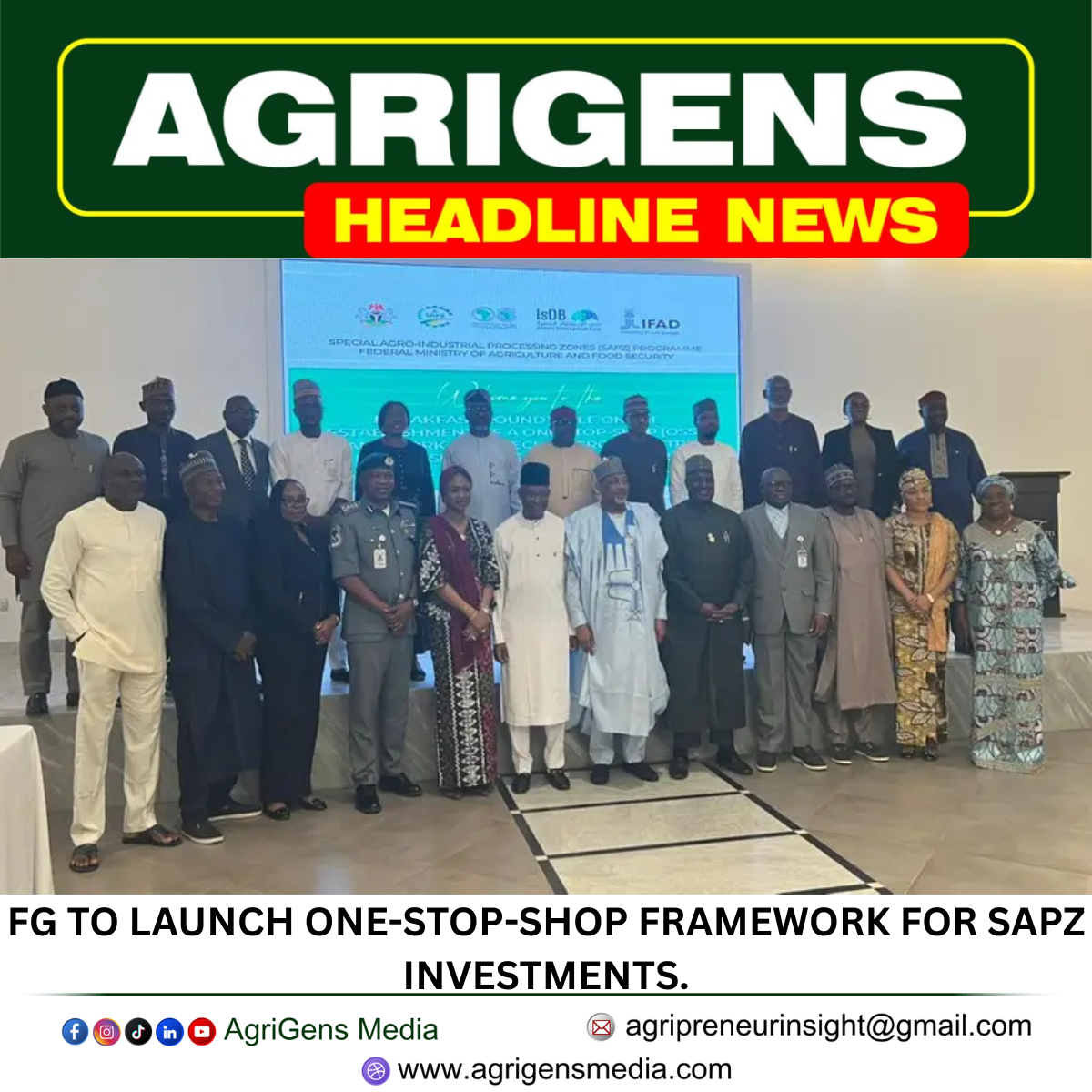
The Federal Government has announced plans to introduce a One-Stop-Shop (OSS) framework for the Special Agro-Industrial Processing Zones (SAPZ) Programme, a strategic move aimed at eliminating bureaucratic bottlenecks and positioning Nigeria as Africa’s leading destination for agro-industrial investments.
The announcement was made during a Breakfast Roundtable Meeting held in Abuja with the theme: “Facilitating Seamless Investment Entry and Operations in Nigeria’s Special Agro-Industrial Processing Zones.”
Speaking at the event, the Minister of Agriculture and Food Security, Senator Abubakar Kyari, said that global investors are no longer attracted solely by market size but by environments where policies, infrastructure and institutions operate efficiently and in harmony.
According to the minister, the proposed One-Stop-Shop framework will simplify investment processes, improve coordination among regulatory agencies and provide investors with easier access to the approvals and services required to establish and operate within the Special Agro-Industrial Processing Zones.
Kyari noted that the initiative is expected to enhance investor confidence, attract greater private sector participation and accelerate the industrialisation of Nigeria’s agricultural sector.
He emphasized that with the implementation of the African Continental Free Trade Area (AfCFTA), which provides access to a market of approximately 1.3 billion people, Nigeria is strategically positioning itself to capture a substantial share of the opportunities presented by intra-African trade.
The minister stated that the SAPZ Programme remains a critical component of the Federal Government’s strategy to promote value addition, reduce post-harvest losses, create employment opportunities and strengthen food security.
He added that the establishment of agro-industrial hubs close to production centres would help lower operational costs, improve market access and stimulate economic growth in rural communities.
Stakeholders at the roundtable stressed the importance of efficient institutions and enabling policies in attracting investments capable of transforming Nigeria’s agricultural value chains.
The Federal Government reaffirmed its commitment to creating a conducive business environment that will support sustainable agro-industrial development and position Nigeria as a competitive player in Africa’s agricultural economy.