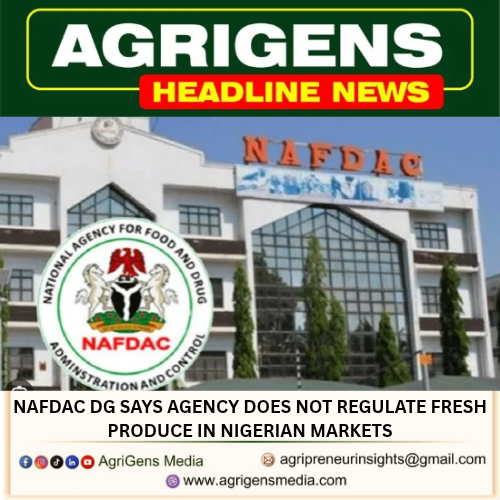
The Director-General of the National Agency for Food and Drug Administration and Control (NAFDAC), Prof. Mojisola Adeyeye, has clarified the agency’s responsibilities in food safety regulation, saying fresh agricultural produce falls primarily under the Federal Ministry of Agriculture and Food Security.
Adeyeye, who spoke with journalists on Monday, 5th of October 2026 said many Nigerians lacked adequate knowledge of food safety regulations, particularly the proper use of pesticides.
She explained that NAFDAC regulates processed and semi-processed foods, while the Ministry of Agriculture is responsible for fresh produce under the food safety framework covering the process from farm to fork.
“NAFDAC mandate is for processed or semi-processed foods. So the oranges you buy in the market, we don’t control the oranges you buy in the market,” she said.
However, Adeyeye noted that NAFDAC regulates and approves pesticides used in agriculture and works with the ministry to educate farmers on correct application rates, timing and the required interval between spraying and harvesting.
She attributed some cases of pesticide misuse to farmers’ difficulty understanding product labels, warning that applying excessive chemicals does not guarantee better results.
Adeyeye cited literacy challenges as one factor affecting compliance, noting that some farmers may struggle to interpret instructions on pesticide products.
She added that NAFDAC’s Veterinary Medicine and Allied Products Directorate trains farmers and other stakeholders on safe pesticide use, but said the agency could not reach millions of farmers nationwide without support from the Ministry of Agriculture.
The NAFDAC chief also said limited public understanding of the responsibilities of government agencies often makes it difficult to determine which institution should address specific food safety concerns.
Her comments come amid growing concerns over suspected counterfeit, substandard and unsafe products in Nigerian markets. NAFDAC continues to conduct enforcement operations against unregistered and unsafe products as part of efforts to protect consumers and improve regulatory compliance.