

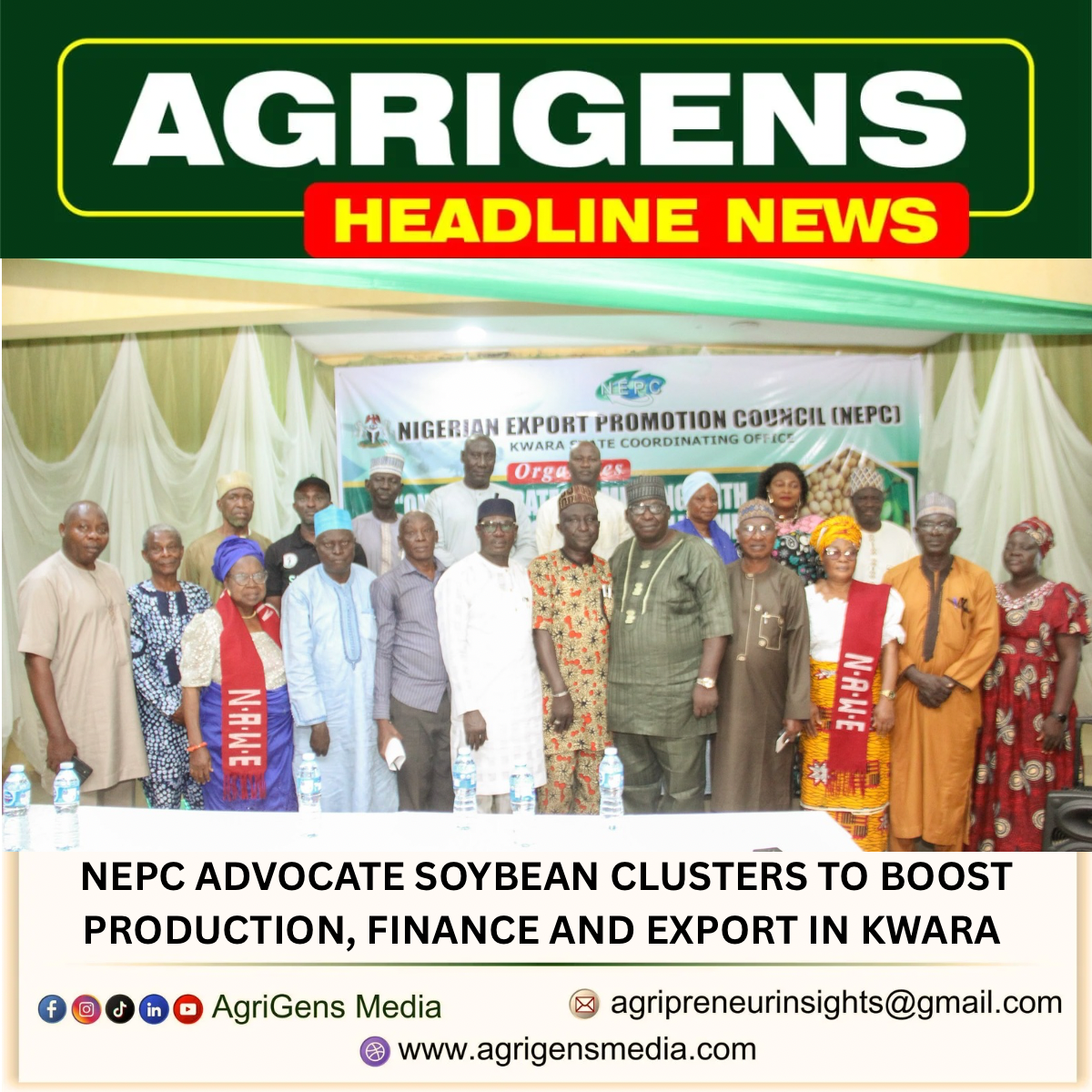
The Nigerian Export Promotion Council (NEPC), through its Kwara State Coordinator, Mr. Olu Ikulajolu, has advocated the adoption of farmer aggregation and cluster-based production as a strategy to improve agricultural productivity, enhance access to finance, strengthen logistics and expand Nigeria’s presence in international markets.
The advocacy was made during a one-day strategic engagement on the establishment of a soybean cluster in Kwara State, held on September 30, 2026, at Forum 13, GRA, Ilorin. The engagement brought together agricultural stakeholders, institutional representatives, entrepreneurs and other key players across the agricultural value chain to discuss opportunities for strengthening soybean production, processing, financing and export.
Among the notable participants were Alh. Ibrahim Adebayo, Vice President, Agriculture, Kwara State Chamber of Commerce, Industry, Mines and Agriculture (KWACCIMA), Ilorin; Evang. Amb. Afolabi Florence Abiodun, State Director of the Nigerian Association of Women Entrepreneurs (NAWE), Ilorin; Dr. Popoola Oluwatoki Peter, Head of Department (HOD), Agripreneurship, ARMIT; and Dr. Miriam Ukemgoam-Ekelgme, State Administrator of the National Agricultural Land Development Authority (NALDA), Kwara State.
Stakeholders emphasised that the cluster model would provide a more coordinated approach to agricultural production by bringing farmers, processors, financial institutions and other value-chain actors together to operate as organised groups rather than individually.
Speaking during the engagement,
Mr Olu Ikulajolu highlighted the importance of farmer aggregation, noting that most farmers in Nigeria operate on a relatively small scale. He explained that clustering farmers would help achieve the production volume required to compete effectively in domestic and international markets.
“The cluster that we are thinking of links farmers together. It is an aggregate of farmers that are either into farming, processing or one way or the other. Since we are not practising large-scale farming in Nigeria, we have a long way to go. We just have to do it in aggregate, cluster by cluster.”
Nigeria Exports Promotion Council state coordinator Mr Olu Ikulajolu also identified quality certification as a major benefit of the cluster system, explaining that organised production would make it easier to maintain standards and ensure the quality of agricultural produce.
Mr Olu Ikulajolu further noted that aggregation could improve farmers’ access to large-scale financing, citing discussions with financial institutions on the importance of farmers organising themselves into cooperatives and business groups to access substantial financial support.
“The only way we can access big finance nowadays is through aggregation. Farmers have to come together, either in cooperatives or as farmers in business, and that is the only way we can have access to big finance.”
On logistics, Stakeholders stressed that the cluster approach would make transportation more efficient by consolidating agricultural produce and facilitating the movement of commodities from Kwara State to major export gateways, including Lagos and Port Harcourt.
He added that international markets require consistent production and reliable supply, which could be achieved through properly organised clusters.
“The international market is looking for large-scale farming where they can be sure that there will be regular supply, and we can only do that if we come together in the form of clusters.”
He expressed optimism that the initiative would serve as a starting point for developing a stronger soybean value chain in Kwara State, creating opportunities for farmers and agribusinesses while supporting agricultural growth and export development.
In her remarks, Evang. Amb. Afolabi Florence Abiodun, State Director of the Nigerian Association of Women Entrepreneurs (NAWE), Ilorin, who disclosed her collaboration with the Nigerian Export Promotion Council (NEPC) on the initiative, described the engagement as timely and significant to Nigeria’s economic diversification efforts.
She stated that the establishment of a soybean cluster aligns with the country’s efforts to strengthen non-oil exports while creating sustainable opportunities for farmers, processors, entrepreneurs and exporters.
“It is a privilege and my pleasure to be part of this important one-day strategic engagement on the establishment of a soybean cluster in Kwara State.”
She emphasised the importance of institutional partnerships in achieving the objectives of the initiative, noting that its success would depend on effective collaboration among government agencies, farmers, processors, financial institutions, researchers, women and youth entrepreneurs, logistics providers and exporters.
According to her, stronger collaboration among these stakeholders would help establish a sustainable soybean production and value-addition ecosystem capable of contributing to economic diversification and export development.
The engagement also provided an opportunity for stakeholders, including Alh. Ibrahim Adebayo of KWACCIMA, Dr. Popoola Oluwatoki Peter of ARMIT and Dr. Miriam Ukemgoam-Ekelgme of NALDA, to contribute institutional perspectives on agricultural development, agripreneurship, land utilisation, farmer organisation and the need for stronger partnerships across the agricultural sector.
The strategic engagement focused on creating a framework that would connect stakeholders across the soybean value chain, promote farmer aggregation, improve access to finance and infrastructure, encourage value addition and position Kwara State to take advantage of growing domestic and international opportunities in soybean production and trade.
The proposed soybean cluster is expected to strengthen cooperation among agricultural stakeholders, improve the organisation of farmers and support the development of an export-oriented agricultural system.
Stakeholders at the engagement called for sustained commitment from relevant institutions and value-chain actors to translate the cluster initiative into practical opportunities for farmers, entrepreneurs and agribusinesses in Kwara State.


