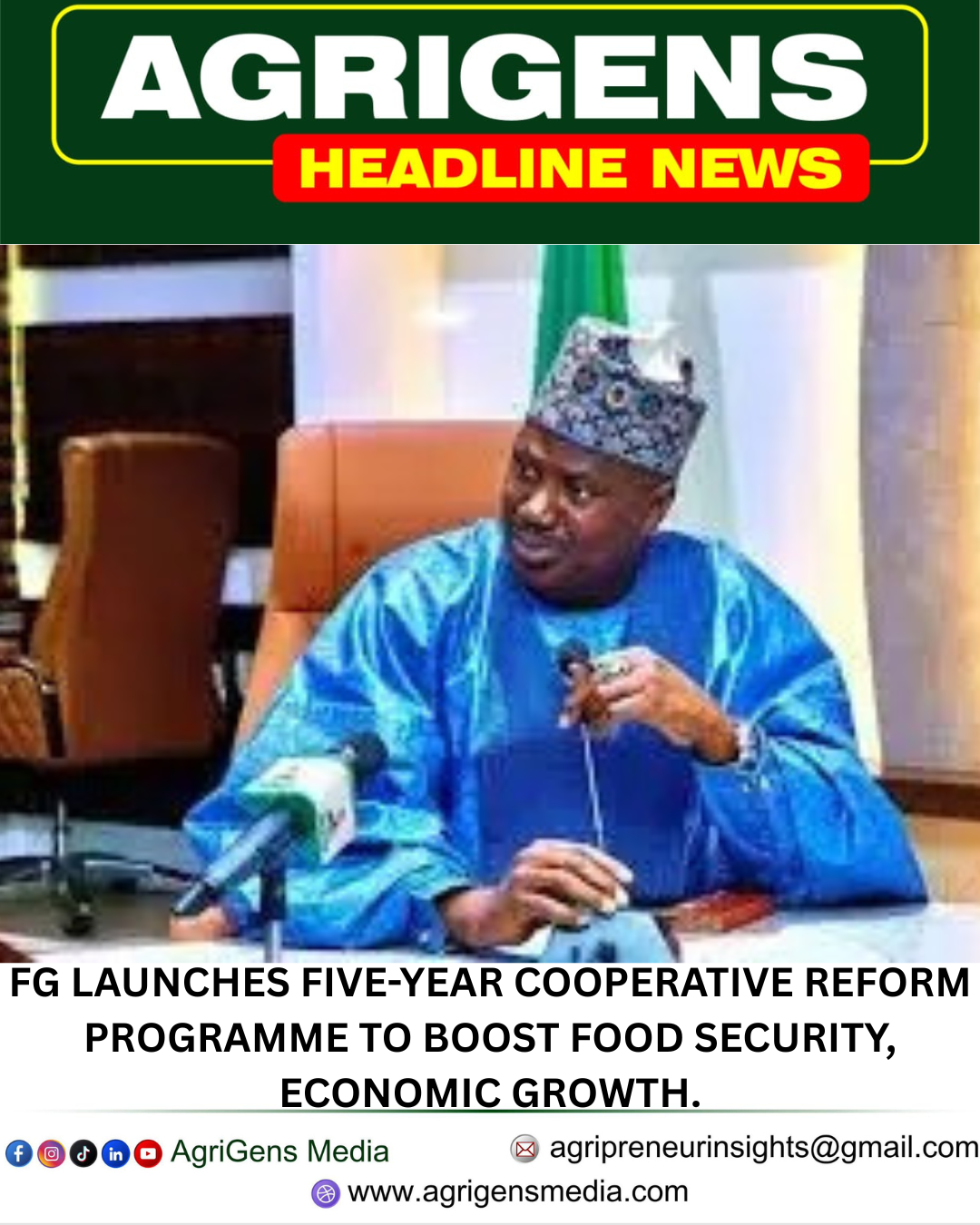
The Federal Government has unveiled an ambitious five-year reform agenda aimed at transforming Nigeria’s cooperative sector into a major driver of food production, rural prosperity, employment generation and national economic growth under the Renewed Hope Agenda.
The initiative known as the Renewed Hope Cooperative Reform and Revamp Programme (RH-CRRP) 2025–2030, is designed to reposition cooperative societies as strategic institutions for inclusive development agricultural productivity, poverty reduction and economic empowerment across the country.
The Minister of State for Agriculture and Food Security Aliyu Sabi Abdullahi, disclosed this during the inauguration of the ministerial technical committee for the programme in Abuja. Represented by the Permanent Secretary of the ministry Olaniyi Ogunbiyi, the minister described the initiative as a direct response to longstanding structural challenges within Nigeria’s cooperative and agricultural sectors.
According to him, the reform programme is expected to strengthen cooperative institutions and enhance their contributions to food security, job creation, rural development and broader economic participation.
The RH-CRRP is built around seven strategic pillars, including cooperative governance and institutional reforms the establishment of the Cooperative Bank of Nigeria, sector-wide digitalisation and data management systems capacity building and cooperative education as well as value chain development and improved market access.
Other focus areas include the inclusion of youths, women and persons with disabilities, alongside strategic partnerships and investment initiatives aimed at strengthening Nigeria’s competitiveness within the global cooperative ecosystem.
Abdullahi noted that the programme would improve access to finance, technology and markets for cooperative societies while fostering stronger collaboration among government institutions, private sector operators, development partners and civil society organisations.
He further charged members of the technical committee to ensure effective implementation of the programme in alignment with the administration of Bola Ahmed Tinubu and its agricultural transformation agenda.
The minister explained that the committee would coordinate policy implementation across relevant ministries and agencies while supporting Farmer Producer Cooperative Organisations and Comparative Cooperative Farms through improved access to farm inputs, aggregation services, extension support and food systems development initiatives, including the Anchor Borrowers’ Programme.
Speaking at the event, Mohammed Abdulkadir said the initiative emerged from resolutions adopted during the 8th Regular Meeting of the National Council on Cooperative Affairs themed Revitalizing Nigeria’s Cooperative Sector.
He explained that the framework would serve as Nigeria’s official roadmap for cooperative transformation, economic revitalisation and digital integration between 2025 and 2030.
Meanwhile, Ogunbiyi highlighted the strategic importance of the Special Agro-Industrial Processing Zones (SAPZ) Programme describing it as a key instrument for accelerating agricultural industrialisation and sustainable economic development.
According to him, the SAPZ initiative is expected to reduce post-harvest losses, improve agricultural productivity, attract private sector investments, generate employment opportunities for youths and women strengthen food security, and promote inclusive economic growth across participating states.
He noted that the programme would establish integrated agro-industrial hubs equipped with critical infrastructure, including road networks, electricity, water supply systems, storage facilities, logistics centres and processing plants located close to major farming clusters.
Ogunbiyi added that the initiative would help transition Nigeria from a raw commodity-exporting economy to a value-driven agro-industrial system focused on processing, industrialisation and increased market competitiveness.
He described SAPZ as one of the Federal Government’s most strategic agricultural transformation projects jointly financed by the Federal Government the African Development Bank International Fund for Agricultural Development, and the Islamic Development Bank, in collaboration with participating state governments and private sector stakeholders.
Also speaking, Kabir Yusuf said the programme was designed to attract private investments into agro-processing while unlocking opportunities in food security export earnings rural development, and job creation.
He noted that the core objective of SAPZ is to support inclusive and sustainable agro-industrial development capable of diversifying Nigeria’s economy through agriculture while reducing dependence on food imports and strengthening the country’s agricultural value chains.