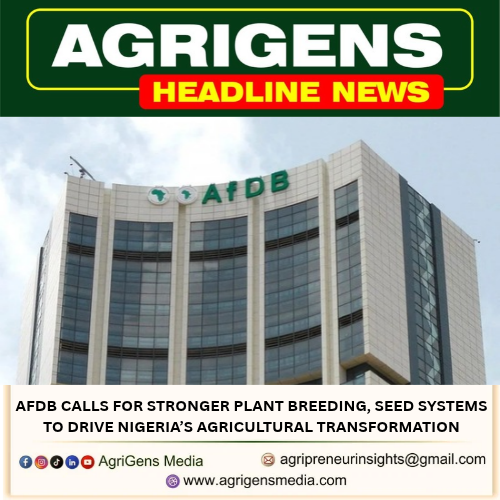
The African Development Bank (AfDB) has called for stronger integration of plant breeding, seed delivery systems, agro-industrialisation and private-sector investment to accelerate Nigeria’s agricultural transformation and strengthen food security.
The Bank’s Officer-in-Charge, Vice-President, Agriculture, Human and Social Development Complex, Dr Martin Fregene, made the call on Wednesday 23rd of September, 2026 at the 4th International Conference of the Nigerian Plant Breeders Association (NPBA) in Abuja.
Fregene, who delivered the keynote address titled, “Agro-Industrialization and Agribusiness Investments in Nigeria: Opportunities for Plant Breeding, Seed Delivery Systems and Sustainable Partnerships,” said improved seeds and agricultural technologies could only achieve their full potential when supported by functional markets, infrastructure, financing, insurance, logistics and processing industries.
“Plant breeding innovations can only transform national food security and rural livelihoods if robust seed systems, well-funded production, agro-industry and logistics are in place,” he said.
He said agricultural transformation required an integrated value chain covering production, aggregation, processing, marketing and supporting infrastructure.
Fregene, a former plant geneticist and breeder, cited improved wheat, cassava and maize varieties as examples of how plant breeding innovations had contributed to increased productivity and food security.
He noted that Nigeria’s cassava production had increased substantially over the years, adding that improved varieties developed by the International Institute of Tropical Agriculture (IITA) and the National Root Crops Research Institute (NRCRI) had contributed to higher yields and the growth of value-added cassava industries.
He also highlighted improved maize varieties, including Striga-tolerant and disease-resistant varieties, as contributors to the expansion of maize production in northern Nigeria.
The AfDB official urged Nigeria and other African countries to move beyond the production and export of raw agricultural commodities by investing more in processing and manufacturing.
Using the cotton value chain as an example, Fregene said West Africa produced about 1.1 million tonnes of raw cotton lint annually but exported about 90 per cent of it, while importing billions of dollars’ worth of fabrics.
He contrasted the situation with Bangladesh, which, despite having a similar number of garment industries, has significantly greater capacity for ginning, spinning and textile processing.
According to him, closing the gap between agricultural production and processing could generate billions of dollars in additional value and create hundreds of thousands of jobs across the region.
He said similar opportunities existed in rice, wheat, soybean, poultry and other agricultural value chains.
“The paucity of ginning, spinning and weaving capacity, which is a failure of our agro-industrialization policy, is costly,” Fregene said, adding that West Africa could earn significantly more from the cotton-to-garment value chain if more processing took place within the region.
Need for Bankable Agricultural Projects
Fregene identified the shortage of bankable agricultural projects and investment-risk reduction mechanisms as major constraints to agricultural transformation.
He said Africa had an estimated $4 trillion in pension funds, insurance companies, banks and equity funds seeking investment opportunities, but more structured agricultural projects were needed to attract the capital.
He called for longer-term and lower-cost financing, de-risking instruments, technical assistance and stronger coordination among governments, investors and agricultural businesses.
Fregene also stressed the importance of regional integration, saying larger regional markets could make African agricultural value chains more competitive.
He cited the African Continental Free Trade Area (AfCFTA) as a step towards creating larger markets and strengthening regional agricultural value chains.
AfDB Unveils Food System Transformation Approach
Fregene said the AfDB was also shifting its approach to agricultural development through the proposed Africa Food System Transformation Platform (AFSTP).
According to him, the platform would bring together governments, private-sector actors, technical and development partners, and civil society organisations to address financing, infrastructure, logistics, market access, regulatory and production gaps across agricultural value chains.
He said the platform would adopt a six-stage process: diagnose, prepare, de-risk, mobilise, deliver and replicate.
The approach, he explained, was designed to move beyond financing individual agricultural projects towards making agricultural transformation more attractive and investable for private capital.
Fregene said the Bank was working with partners, including the African Agricultural Technology Foundation (AATF), to advance the initiative.
AfDB Urges Breeders to Link Innovation With Market Demand
Fregene urged Nigerian plant breeders to strengthen collaboration with processors, millers, brewers, exporters, seed companies and other market actors to ensure breeding programmes respond more directly to market demand.
He proposed the creation of an electronic catalogue containing information on crop varieties, their areas of adaptation and potential uses.
He said the AfDB, through its Technologies for African Agricultural Transformation (TAAT) programme and other initiatives, was prepared to support demand-led breeding and seed systems for priority crops, including cassava, rice, maize, soybean, sorghum, cowpea, tomato and horticultural crops.
Fregene also described seed delivery as a business ecosystem requiring stronger financing for early-generation seed production, private seed companies, agro-dealer networks, digital advisory services and last-mile distribution.
“A variety that does not reach a farmer’s field is at best a journal article and, at worst, wasted resources, not a solution,” he said.
He called on Nigerian banks and investors to recognise seed companies as critical infrastructure for food security and provide them with affordable financing and risk coverage.
Fregene further urged NPBA members to package their innovations into commercially viable and investable propositions, embrace private seed companies as delivery partners and deliberately mentor young scientists.
He said the AfDB would continue to support the sector by helping to de-risk agricultural investments, finance critical systems and promote policies that connect improved seeds to industries and markets.
Fregene said Nigeria possessed the scientific capacity, market size and entrepreneurial energy required to demonstrate agricultural transformation at scale.
“Ultimately, Africa’s agricultural transformation will be determined not by how many technologies we develop, but by how many farmers use them productively, how many businesses build upon them, how much investment they unlock, and how much food and economic opportunity they create,” he said.