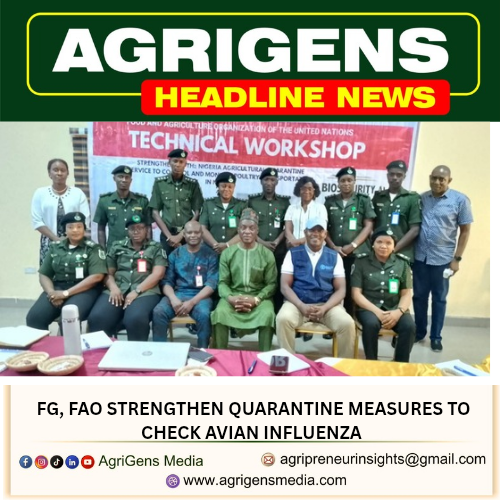
The Federal Government, in collaboration with the Food and Agriculture Organization of the United Nations (FAO), has intensified efforts to contain Avian Influenza in Nigeria through stricter animal movement controls, improved disease surveillance and stronger biosecurity measures.
The initiative also seeks to strengthen stakeholder collaboration across the poultry value chain to prevent the spread of the disease and protect Nigeria’s livestock industry.
The Head of the Department of Animal Health and Reproductive Services and National Programme Coordinator of the Avian Influenza Control Programme at the Federal Ministry of Livestock Development, Dr. Mitchell Alao, disclosed this while representing the Federal Government at a workshop on strengthening the Nigeria Agricultural Quarantine Service (NAQS) in Keffi, Nasarawa State, on Thursday, October 22rd, 2026.
Dr. Alao stressed that NAQS plays a critical role in controlling animal movement during Avian Influenza outbreaks, noting that restricting the movement of infected birds is essential to preventing the disease from spreading to unaffected areas.
He identified disease surveillance, effective risk communication and sustained engagement with stakeholders across the poultry value chain as key strategies for containing outbreaks.
“The idea is to keep the disease in the location where it has occurred. It is basically like covering something with a blanket so that what is covered does not escape. The Quarantine Service is there to ensure that affected birds are not moved out of locations where an outbreak has occurred,” Dr. Alao explained.
He emphasised the need to strengthen institutional capacity and collaboration with security agencies and government institutions, including the Nigeria Security and Civil Defence Corps, the Nigeria Police Force, state governments and local government authorities.
According to him, such partnerships would improve regulatory compliance, strengthen enforcement and ensure a coordinated response to Avian Influenza outbreaks across the country.
Dr. Alao also disclosed that the US$350,000 intervention grant provided by FAO through its Technical Cooperation Programme for Emergencies to support Avian Influenza control in Nigeria is expected to end in April 2027.
Speaking at the workshop, the FAO Country Team Lead for Livestock in Nigeria, Dr. Otto Vianney, revealed that the organisation had developed a digital tool for collecting global animal movement data to improve the monitoring and tracking of livestock transportation.
Dr. Vianney explained that the workshop was designed to assess the contribution of animal movement to the spread of animal diseases in Nigeria while strengthening public awareness, community education and understanding of preventive measures.
He also outlined the four pillars of the Good Emergency Management Practices (GEMP) Framework prevention and preparedness early detection and early response, eradication and recovery and coordination and communication.
He noted that the framework provides a structured approach to managing animal health emergencies and minimising the impact of disease outbreaks.
Also speaking, the North-Central Zonal Commander of NAQS, Dr. David Shehu, said strengthening the control, monitoring and surveillance of poultry transportation was not intended to restrict trade but to protect investments, safeguard national food safety and sustain the supply of essential animal products to millions of households.
He added that effective animal movement control would help preserve jobs and protect livelihoods across urban and rural communities.
Dr. Shehu identified key priorities for maintaining a productive and profitable poultry sector to include strict enforcement of biosecurity measures during animal transportation, proper documentation, regular updating of designated control posts and the prevention of illegal and unregulated animal movement.
Other priorities, he said, include promoting public-private partnerships, encouraging shared responsibility, integrating technology into monitoring systems and ensuring strict compliance with existing regulations.
However, he highlighted several challenges confronting the agency, including porous alternative routes, poor compliance with regulations, inadequate infrastructure and risks associated with transporting live animals.
A major highlight of the workshop was an inspection visit to the Garuku Toll Gate along the Akwanga Road in Kokona Local Government Area of Nasarawa State to assess animal movement procedures and the effectiveness of existing monitoring and control measures.
During the exercise, NAQS officers inspected three vehicles transporting livestock. The first vehicle conveyed nine cattle from Lafia, while the second carried a mixed consignment of cattle, goats, sheep and poultry. Temperatures of 35.9°C and 34.7°C were recorded during the inspection.
The third truck was transporting 35 cattle from Adamawa State to Warri, Delta State with a valid animal movement permit.
Following the inspection, Dr. Vianney urged NAQS officers to be more proactive in discharging their responsibilities, stressing that effective monitoring, surveillance and control of animal movement were essential to preventing the spread of transboundary animal diseases and protecting Nigeria’s livestock industry.
The Federal Ministry of Livestock Development reiterated the need for sustained collaboration among government agencies, development partners, security institutions, livestock farmers, transporters and other stakeholders to strengthen animal disease prevention and control systems.
The ministry noted that these efforts would help safeguard livelihoods, protect the livestock industry and promote a resilient and productive sector in line with the Federal Government’s commitment to transforming Nigeria’s livestock industry.