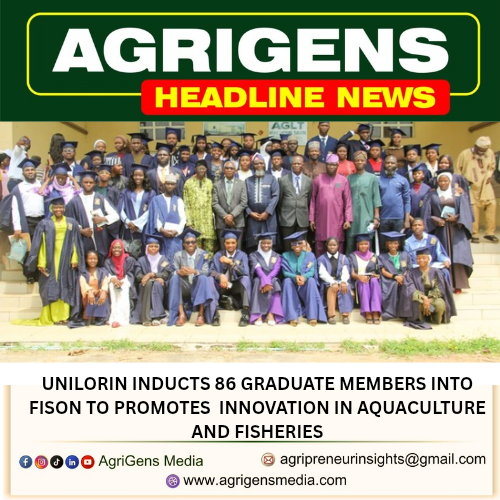
The University of Ilorin (UNILORIN) has inducted 86 graduating students of its Department of Aquaculture and Fisheries into the Fisheries Society of Nigeria (FISON), charging them to embrace professionalism, innovation and entrepreneurship to advance Nigeria’s fisheries and aquaculture sector.
The induction took place on Thursday, October 15th, 2026, during the department’s 2nd Induction Ceremony and Professional Orientation Programme, organised in collaboration with the FISON Kwara State Chapter at the Faculty of Agriculture Lecture Theatre, UNILORIN, Ilorin.
Held under the theme, “Strengthening Professionalism and Innovation for Sustainable Fisheries and Aquaculture Development in Nigeria,” the ceremony brought together academics, fisheries professionals, industry stakeholders and students to discuss strategies for strengthening the sector and preparing young professionals for emerging challenges and opportunities.
Delivering the welcome address, the Head of the Department of Aquaculture and Fisheries, Prof. W. A. Jimoh, said the future of Nigeria’s aquatic sector depended on more than increasing fish production. He stressed the need for improved fish health and nutrition, responsible resource management, efficient production systems, value addition and technological innovation.
He also identified the reduction of post-harvest losses as a critical factor in improving the profitability and sustainability of fisheries and aquaculture enterprises.
According to him, FISON plays an important role in connecting classroom learning and scientific research with commercial practices, helping young professionals acquire the knowledge and skills required to address challenges in the industry.
Jimoh urged the inductees to embrace continuous learning and practical problem-solving, noting that the development of the sector required professionals who could translate scientific knowledge into practical solutions for fish farmers and other industry operators.
The National President of FISON, Dr. (Mrs.) Ebinimi Joseph Ansa, Ffs, represented by Dr. N. O. Bankole, called on the Federal Government to introduce fisheries as a trade subject in the West African Senior School Certificate Examination (WASSCE), administered by the West African Examinations Council (WAEC).
Speaking at the ceremony, Ansa said introducing fisheries education at the secondary school level would expose young people to the sector early and encourage sustained interest in fisheries-related courses at undergraduate and postgraduate levels.
She explained that strengthening fisheries education from the foundational level could help develop a new generation of professionals equipped to contribute to aquaculture development, research, fish production and the broader blue economy.
The FISON president also highlighted the society’s capacity-building initiatives, including training on river prawn and marine shrimp farming organised in collaboration with the African Regional Aquaculture Centre (ARAC).
The training, she said, attracted more than 20 participants, including 15 students undertaking their Students Industrial Work Experience Scheme (SIWES).
Ansa further announced that FISON’s 50th anniversary celebrations would culminate in its Annual Conference and Annual General Meeting (AGM), scheduled to be hosted by the Federal University of Agriculture, Abeokuta (FUNAAB).
She charged the newly inducted members to uphold the society’s creed, demonstrate patriotism and ethical conduct, and participate actively in the activities of its national and state chapters.
The president stressed that professional membership should go beyond receiving an induction certificate, urging the graduates to remain committed to advancing fisheries knowledge, promoting industry best practices and contributing meaningfully to national development.
Delivering the keynote address, the President of the Association of Fish Farmers in Kwara (AFFAK), Brigadier General S. T. Olasupo (rtd.), emphasised the connection between food security, national security and economic sustainability.
Olasupo noted that although the establishment of the Federal Ministry of Marine and Blue Economy represented an important institutional framework for developing the sector, achieving meaningful progress would require practical action, investment, innovation and collaboration among stakeholders.
He identified sustainable innovation, biosecurity, collaboration between academia and industry, and environmental protection as key areas where the newly inducted fisheries professionals must make significant contributions.
On innovation, he encouraged the adoption of locally adaptable technologies and alternative feed ingredients, including Black Soldier Fly larvae, to reduce dependence on conventional protein sources and improve the affordability of fish feed.
He also highlighted the potential of Recirculating Aquaculture Systems (RAS), smart water-quality monitoring tools and improved breeding stocks to enhance production efficiency and strengthen the resilience of aquaculture enterprises.
According to him, adopting appropriate technologies could help fish farmers improve productivity, manage resources more efficiently and respond to emerging challenges in the industry.
The AFFAK president also stressed the importance of biosecurity and quality assurance, urging the inductees to enforce proper hygiene practices, quarantine procedures and other preventive measures to minimise the risk of disease outbreaks on fish farms.
The Chairman of the FISON Kwara State Chapter, Dr. Bamidele Folorunsho, acknowledged the presence and contributions of stakeholders, professionals, invited guests, parents and the inductees.
During the technical session on “Strengthening Professionalism and Innovation for Sustainable Fisheries and Aquaculture Development in Nigeria,” Folorunsho encouraged the inductees to join the workforce and explore the numerous opportunities available in the fisheries sector.
He cited Brigadier General Olasupo as an example of someone who did not study fisheries but remained actively involved in the sector. He noted that significant gaps existed within the industry and that the workload was enormous, adding that the newly inducted professionals could help fill these gaps.
Folorunsho described FISON as the apex professional body for fisheries in Nigeria and urged the inductees to consider themselves fortunate to be part of the society.
He noted that FISON was established in 1976 and explained that fisheries offered numerous value-chain opportunities for professionals to explore. He encouraged the inductees to identify their areas of specialisation, become problem-solvers and embrace innovation rather than focus solely on securing white-collar jobs.
Dr. N. O. Bankole subsequently inducted the new members into FISON, as Nigeria continues to explore the opportunities offered by its marine and blue economy, the newly inducted professionals are expected to apply their knowledge and skills to improving fish production, reducing post-harvest losses, supporting farmers and promoting the sustainable management of aquatic resources.
The speakers urged the inductees to regard their professional membership as a responsibility to contribute to the growth of the sector and uphold standards that will strengthen public confidence in fisheries and aquaculture practice.