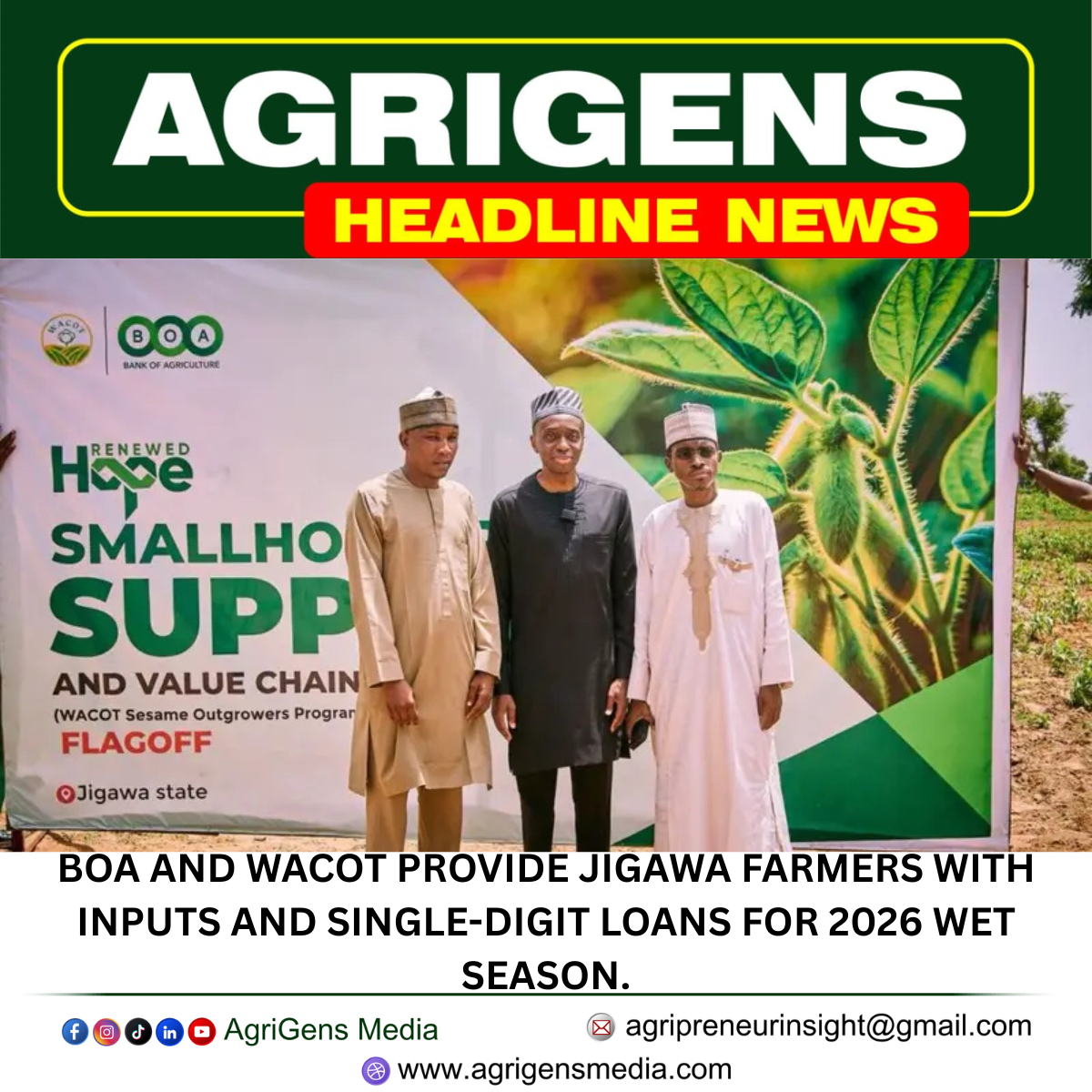
Smallholder farmers in Jigawa State have received a major boost for the 2026 wet season farming following the distribution of farm inputs and access to single-digit agricultural loans under a partnership between the Bank of Agriculture (BoA) and WACOT Limited.
The intervention is being implemented under the Federal Government’s Renewed Hope Smallholder Farmer Support and Value Chain Programme, with the aim of improving farmers productivity through access to quality inputs, financing, extension services and guaranteed markets.
Speaking at the flag-off ceremony in Jigawa, the Managing Director and Chief Executive Officer of the Bank of Agriculture, Ayo Sotinrin, represented by the Executive Director, Operations and Technology, Tosin Salami, described the initiative as a new approach to agricultural financing that brings government, financial institutions and the private sector together.
He said beneficiaries would receive improved seeds, fertilisers, agrochemicals, technical support and guaranteed off-take arrangements designed to increase productivity and profitability.
Sotinrin disclosed that the national intervention targets more than two million smallholder farmers across over 20 states, with plans to distribute more than 10 million bags of fertiliser, improved seeds and structured financing.
He added that more than one-third of the beneficiaries are women.
According to him, about 200,000 farmers are expected to benefit during the current wet season, while the number is projected to rise to 500,000 farmers during the dry season.
“Our goal is not only to provide inputs but to significantly increase farmers’ yields,” he said, noting that improved seeds, quality inputs and proper agronomic support could raise productivity from the current 1–1.5 tonnes per hectare to between 3 and 5 tonnes per hectare.
The BoA chief also disclosed plans to expand irrigation support to promote year-round farming, enabling smallholder farmers to cultivate up to four times annually instead of depending entirely on rainfall.
Under the programme, each beneficiary is expected to receive an input package containing improved seeds, two to three bags of fertiliser and about 20 litres of agrochemicals.
Sotinrin clarified that the intervention is a loan programme and not a grant, with beneficiaries accessing financing at a single-digit interest rate of nine per cent through Federal Government intervention funds.
He said each package is valued at approximately ₦500,000, while participating farmers are expected to generate up to ₦1.5 million at the end of the production cycle.
The loans, he explained, are repayable within nine months and will be disbursed through accredited farmer aggregation companies, including WACOT Limited.
He urged beneficiaries to repay the loans promptly to sustain the revolving fund and ensure that other farmers can benefit from subsequent interventions.
Sotinrin commended the Jigawa State Government for its investments in agricultural extension services, irrigation and climate-smart farming, while also acknowledging the Renewed Hope Agenda of President Bola Ahmed Tinubu for prioritising food security and agricultural financing.
The Managing Director of WACOT Limited, Naveen Chaurasia, reaffirmed the company’s commitment to improving smallholder farmers’ access to quality inputs, modern agronomic practices and structured out-grower schemes for sesame, rice and soybean production.
Chaurasia noted that poor-quality inputs and inadequate agronomic practices remain major constraints to agricultural productivity, stressing that the partnership would help address these challenges by providing farmers with the right inputs and technical knowledge.
Representing the Gumel Emirate Council, Alhaji Musa Ayuba described the intervention as timely, noting that it would strengthen farming communities and support sesame production, which remains a major economic activity in the emirate.
He urged the Bank of Agriculture to sustain affordable agricultural financing and expand insurance coverage to protect farmers against climate-related risks.
Ayuba also assured stakeholders that the traditional institution would mobilise farmers to participate in the programme and encourage beneficiaries to meet their loan repayment obligations.
The intervention is expected to strengthen smallholder farming in Jigawa State by combining affordable financing, improved inputs, technical support and market access, while contributing to the Federal Government’s broader efforts to increase food production and improve farmers incomes.