

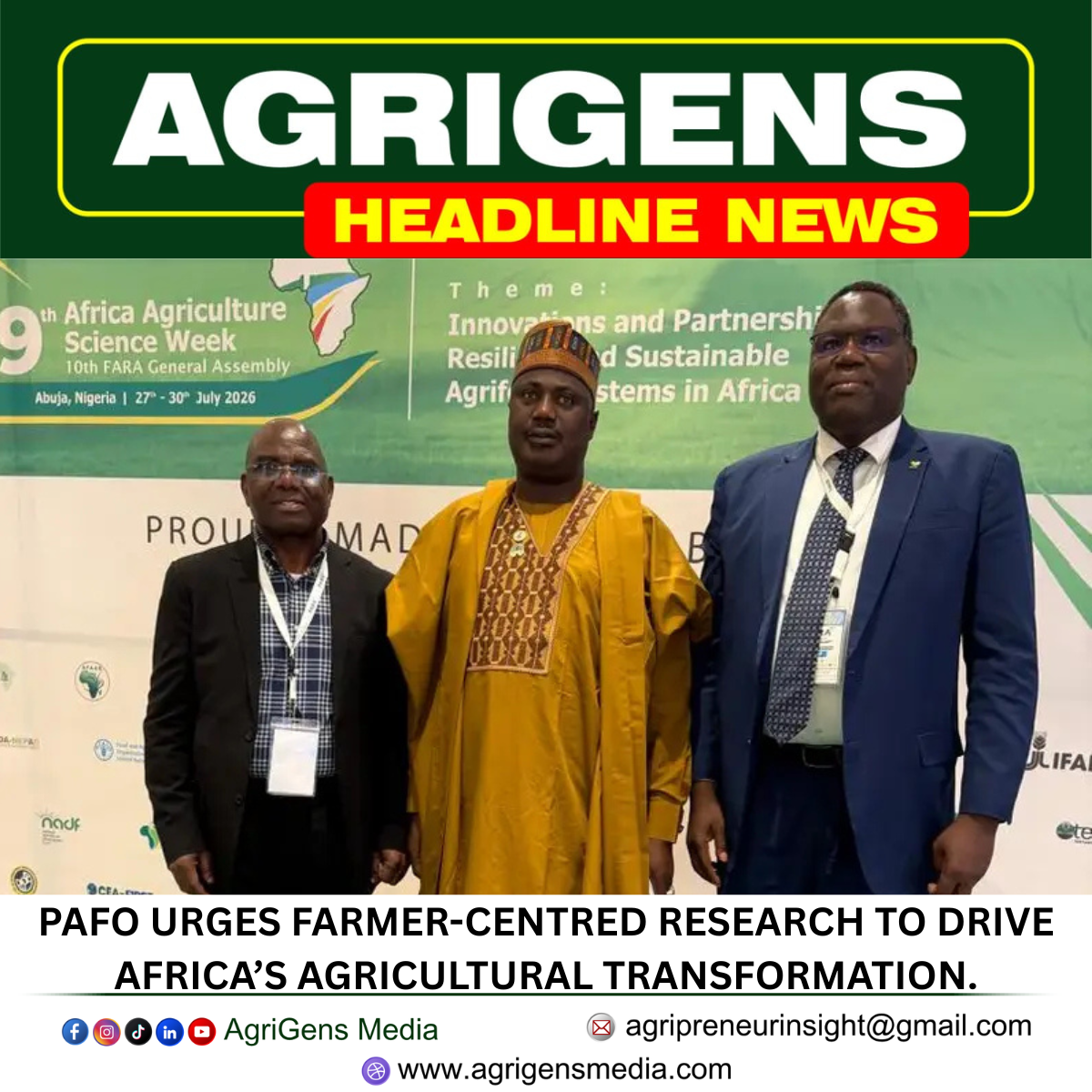
The Pan-African Farmers Organization (PAFO) has called for a fundamental transformation of Africa’s agricultural research system, urging governments, research institutions and development partners to place farmers at the centre of innovation and technology development.
The call was made during the opening session of the 9th Africa Agriculture Science Week (AASW) and the 10th Forum for Agricultural Research in Africa (FARA) General Assembly, held in Abuja from July 27 to 30 under the theme, “Innovations and Partnerships for Resilient and Sustainable Agrifood Systems in Africa.”
Delivering PAFO’s partners statement, the organisation’s Chief Executive Officer, Dr. Babafemi Oyewole, said Africa’s agricultural transformation would only be achieved when research and innovation are driven by the realities, experiences and needs of farmers.
Speaking on behalf of more than 250 million farmers represented by PAFO’s regional and national member organisations across 50 African countries, Oyewole described the gathering as timely as the continent begins implementing the Comprehensive Africa Agriculture Development Programme (CAADP) Kampala Declaration Strategy and Action Plan (2026–2035).
He noted that African agriculture is facing increasing pressure from climate change, soil degradation, rising production costs, geopolitical uncertainties, volatile markets and persistent food insecurity.
According to him, tackling these challenges requires stronger collaboration among researchers, policymakers, development partners and farming communities.
Oyewole stressed that farmers should no longer be regarded merely as beneficiaries of agricultural research but as co-innovators, whose indigenous knowledge, practical experience and ability to adapt to changing climatic conditions should influence research priorities, technology development, testing and deployment.
He observed that although Africa has produced numerous agricultural innovations, the major challenge remains taking proven technologies from research institutions and pilot projects to millions of farmers across the continent.
The PAFO chief expressed concern that many research findings remain largely within academic and research institutions, while smallholder farmers continue to face limited access to quality extension services, digital advisory platforms and practical training.
He identified farmer organisations as one of the most effective channels for accelerating technology adoption, noting that organised farmer networks can help distribute innovations while providing researchers with valuable feedback on their effectiveness under real farming conditions.
Oyewole therefore called for stronger institutional frameworks that would enable farmer organisations to participate directly in setting agricultural research priorities, testing technologies and evaluating their impact on productivity, resilience and rural livelihoods.
He also urged African governments and development partners to increase investment in climate-resilient crop varieties, sustainable soil management, regenerative agriculture, affordable mechanisation, resilient seed systems, digital technologies, artificial intelligence and agricultural value addition.
He emphasised the need to strengthen agricultural extension systems so that research-based innovations can reach farmers in practical and accessible forms.
Highlighting PAFO’s growing partnership with FARA, Oyewole said the Memorandum of Understanding signed between both organisations in January 2026 demonstrates their shared commitment to narrowing the gap between agricultural research and farmers.
He added that PAFO’s representation on the FARA Board would further strengthen efforts to ensure that farmers perspectives are incorporated into the governance and strategic direction of Africa’s agricultural research system.
Oyewole reaffirmed PAFO’s commitment to working with FARA, governments, researchers and other stakeholders to build resilient and inclusive food systems across Africa.
He maintained that the continent’s agricultural prosperity is ultimately tied to the prosperity of its farmers, stressing the need for an innovation ecosystem that is farmer-centred, science-driven and focused on measurable impact.


