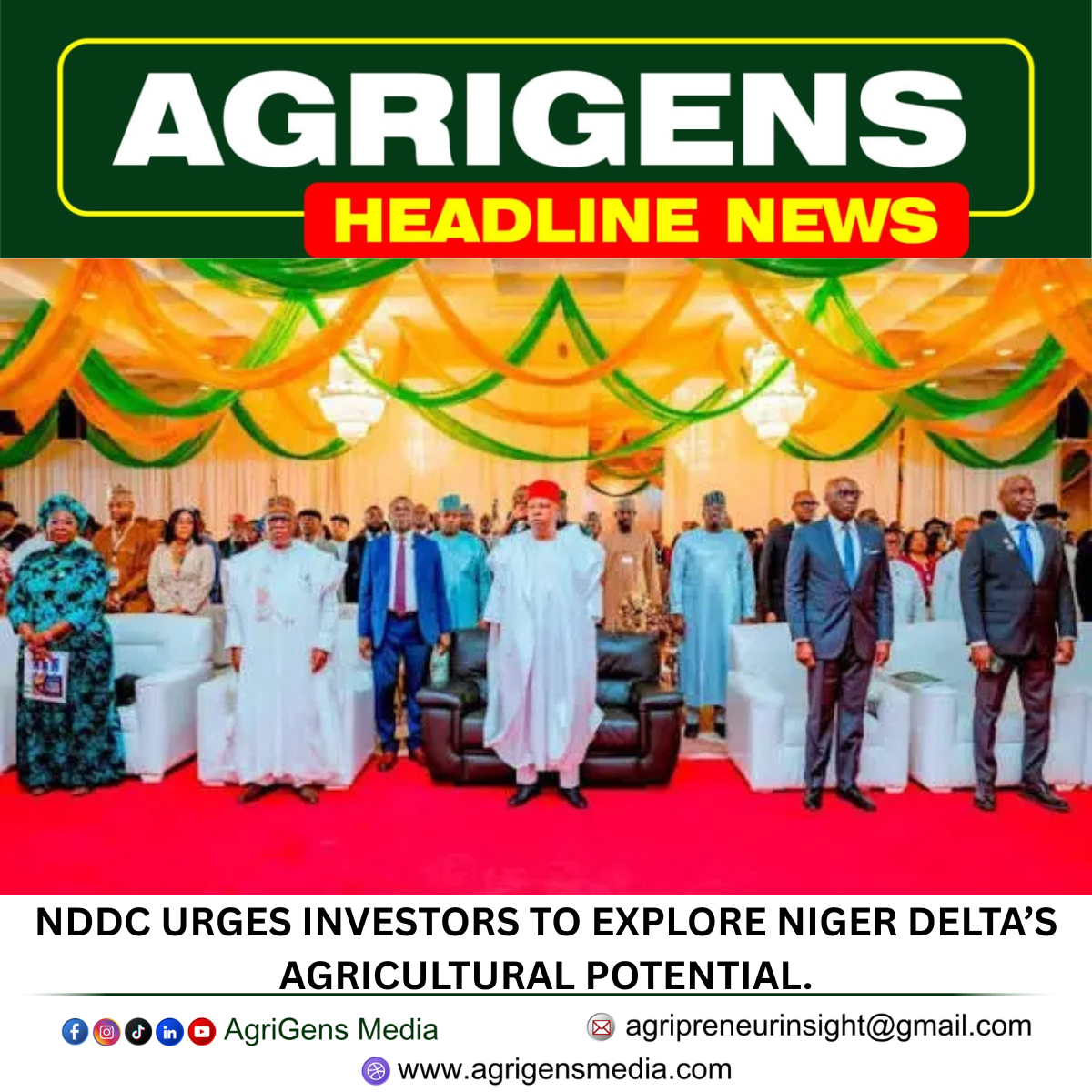
The Niger Delta Development Commission (NDDC) has called on local and international investors to take advantage of the vast agricultural opportunities in the Niger Delta, describing the region as one of Nigeria’s most promising frontiers for sustainable agriculture and agro-industrial investment.
The appeal was made during the Niger Delta Agricultural Development and Investment Summit 2026, held at the Banquet Hall, State House, Presidential Villa, Abuja. The summit, organised by the NDDC in collaboration with the Office of the Vice President, was themed “Unlocking Investment for Sustainable Agricultural Transformation in the Niger Delta.”
Niger Delta Offers Strong Investment Fundamentals
Speaking at the summit, the NDDC Director of Agriculture and Fisheries, Dr. Winifred Madume, said the Niger Delta possesses the natural resources and economic advantages required to become a leading agricultural investment destination.
She highlighted the region’s fertile farmland, abundant freshwater resources, extensive coastlines and inland waterways, diverse ecological zones and strategic access to domestic and export markets across the commission’s nine mandate states.
According to Madume, the Niger Delta presents significant investment opportunities in crop production, aquaculture, livestock development, agro-processing and agricultural trade, stressing that the region’s greatest challenge has been inadequate investment rather than a lack of agricultural potential.
She noted that agriculture has become a strategic global investment sector and described the summit as an important platform for connecting governments, development partners and private investors to unlock the region’s agricultural economy.
Madume identified fisheries and aquaculture, crop value addition, livestock development and agricultural infrastructure as priority investment areas.
She observed that Nigeria’s continued dependence on imported fish demonstrates the need to expand domestic fish production, processing and distribution, while emphasising that greater economic returns would come from processing agricultural commodities into finished products instead of exporting raw produce.
She also underscored the importance of investing in rural roads, electricity, irrigation systems, storage facilities and processing centres, describing such infrastructure as critical to building a competitive agricultural economy capable of attracting long-term private investment.
Madume invited both local and foreign investors to partner with the Niger Delta through investments in technology, finance and technical expertise to increase food production, create jobs and strengthen national food security.
Niger Delta Is More Than an Oil Region
In his goodwill message, Chairman of the NDDC Governing Board, Mr. Chiedu Ebie, said the Niger Delta should be recognised not only for its oil and gas resources but also for its enormous agricultural potential.
He explained that while the region has long been blessed with fertile land, abundant water resources and a vibrant youthful population, what has been lacking is effective coordination, strong institutions and strategic partnerships capable of transforming agriculture into a commercially competitive industry.
Ebie said the summit reflects a renewed commitment to strengthening agricultural value chains, encouraging collaboration among governments, development partners and private investors, and promoting commercially viable projects capable of attracting sustainable investment.
He reaffirmed the commission’s commitment to repositioning agriculture as a profitable business and expressed appreciation to President Bola Ahmed Tinubu, Vice President Kashim Shettima and the governors of the nine Niger Delta states for supporting the initiative.
Origin Tech Calls for Stronger Agricultural Structures
Delivering the keynote address titled “Niger Delta: Awakening an Agricultural Giant,” Founder and Executive Chairman of Origin Tech Group, Prince S.J. Samuel, argued that weak institutional structures—not a shortage of natural resources—remain the greatest obstacle to agricultural transformation in the Niger Delta.
He described the region as one of Africa’s richest agricultural landscapes, endowed with fertile land, extensive fisheries resources and favourable ecological conditions capable of supporting large-scale food production.
Samuel noted that previous government interventions, including tractor distribution and farm input support, have delivered only limited results because they failed to address deeper structural issues affecting the agricultural sector.
He stressed that modern agriculture is no longer driven by subsistence farming but by efficient value chains, modern infrastructure, organised markets and coordinated investment.
According to him, strengthening coordination across the agricultural value chain would reduce investment risks, improve farmers’ productivity and create a more attractive environment for commercial agriculture.
Samuel also highlighted Origin Tech Group’s investments in mechanisation, food systems, logistics and agricultural infrastructure, maintaining that improved infrastructure and stronger institutions are essential to unlocking opportunities for farmers, agribusinesses and investors.
He urged the NDDC and other stakeholders to champion reforms that prioritise mechanisation, value-chain development and institutional strengthening, expressing confidence that the Niger Delta can emerge as one of Nigeria’s leading centres for agricultural production, agro-processing and agribusiness investment.
Stakeholders Call for Coordinated Action
Participants at the summit agreed that the Niger Delta possesses the natural resources required to become a major agricultural hub, but stressed that achieving this vision will require sustained investment in infrastructure, stronger institutional coordination, efficient value chains and deeper collaboration between government and the private sector.
The summit brought together policymakers, development partners, financial institutions and agribusiness stakeholders to explore practical strategies for mobilising investment, expanding agricultural value chains and accelerating sustainable agricultural transformation across the Niger Delta.