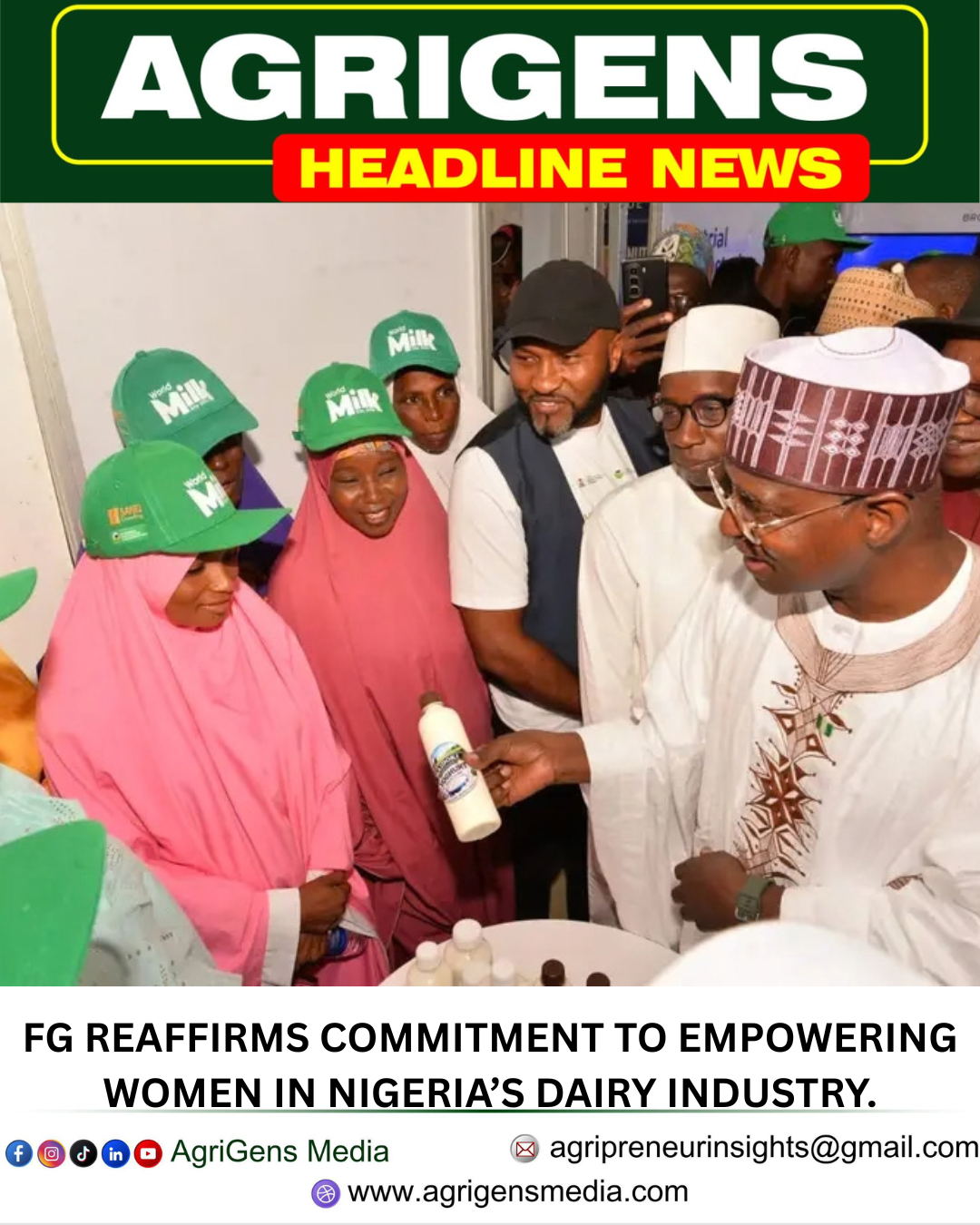
The Federal Government has reaffirmed its commitment to empowering women in Nigeria’s dairy industry describing them as critical stakeholders in the drive to strengthen food security improve household nutrition enhance rural livelihoods and achieve self-sufficiency in milk production.
The Minister of Livestock Development Idi Maiha, made this known in Abuja during a press briefing held ahead of the 2026 World Milk Day celebration.
Maiha stated that women occupy a central position within Nigeria’s dairy value chain, contributing significantly to milk production, preservation, storage, processing and marketing. He stressed that meaningful transformation of the dairy sector cannot be achieved without their active participation and economic empowerment.
According to the minister, the Federal Ministry of Livestock Development has intensified efforts to promote gender-responsive policies and interventions through the strengthening of dairy cooperatives, skills acquisition programmes, milk aggregation systems, value-addition initiatives and enterprise support schemes.
He noted that the theme for this year’s World Milk Day celebration, “Celebrating Women Farmers” recognises the immense contributions of women to dairy development and the broader agricultural economy.
The minister disclosed that Nigeria continues to face a significant gap between milk demand and domestic production. He explained that annual national demand is estimated at 1.7 million metric tonnes while local production currently ranges between 600,000 and 700,000 metric tonnes.
According to him the production deficit has sustained heavy reliance on dairy imports resulting in annual foreign exchange expenditures exceeding $1.5 billion.
Despite the challenge Maiha expressed confidence that ongoing reforms under President Bola Tinubu’s Renewed Hope Agenda and the establishment of the Federal Ministry of Livestock Development are creating a foundation for a more productive, competitive and sustainable dairy industry.
He revealed that the ministry will officially unveil the validated Implementation Framework of the National Dairy Policy during the World Milk Day Conference scheduled for June 1, 2026.
The framework developed through extensive stakeholder consultations is expected to guide investments and interventions in local milk production, dairy processing, cold-chain infrastructure, milk aggregation systems, pasture development, ranching facilities, animal health services and private sector participation.
Highlighting growing investor interest in the sector Maiha disclosed that major dairy companies, including Arla Foods, FrieslandCampina WAMCO, Nestlé and Danone, have continued to expand their commitments to Nigeria’s dairy industry.
He further announced that Pure Dairy Herds plans to establish a 5,000-cow dairy farm in Ogun State alongside training centres in Ogun and Taraba State and a 5,000-member smallholder out-grower scheme.
The minister also revealed that the Nigeria Sovereign Investment Authority recently signed a $496 million Memorandum of Understanding with Asset Green Limited for the development of an integrated dairy livestock production and processing project in Nigeria.
According to him the project will feature a 10,000-milking-cow dairy operation, large-scale fodder production facilities and a modern processing plant capable of producing fresh milk, butter, cream, milk powder and infant formula.
Maiha noted that the initiative is expected to generate approximately 2,500 direct jobs and more than 5,000 indirect jobs across the dairy value chain.
He added that the ministry is advancing implementation of the National Livestock Growth Acceleration Strategy (NL-GAS) which prioritises dairy industrialisation through investments in feed and fodder development, improved animal health services, cold-chain systems, enhanced genetics, dairy hubs, milk aggregation centres, infrastructure development and climate-smart livestock practices.
As part of efforts to deepen inclusion the minister announced plans for a Women and Youth in Livestock Empowerment Initiative aimed at creating economic opportunities for about 37,000 women and young people across livestock value chains nationwide.
According to him the programme is currently undergoing stakeholder consultations and final design processes and is expected to be launched in the next phase of the ministry’s livestock transformation agenda.
Maiha further disclosed that the ministry is exploring the establishment of women-led milk aggregation and processing cooperatives in grazing reserves while continuing capacity-building programmes targeted at smallholder dairy farmers.
Earlier the Permanent Secretary of the ministry Chinyere Akujobi, described the World Milk Day activities as a reflection of stakeholders collective commitment to improved nutrition, healthier lifestyles and sustainable livestock development.
Akujobi noted that the 2026 theme appropriately recognises the vital role women play in dairy production, food security and rural economic development adding that women and youth empowerment remain key pillars of the National Livestock Growth Acceleration Strategy.
She called on stakeholders to sustain support for initiatives designed to strengthen the dairy industry improve local milk production and increase public awareness of the nutritional and economic importance of milk and dairy products.
Stakeholders at the briefing observed that empowering women within the dairy value chain will be critical to achieving national dairy self-sufficiency, reducing import dependence, improving rural incomes and supporting Nigeria’s broader agricultural transformation agenda.