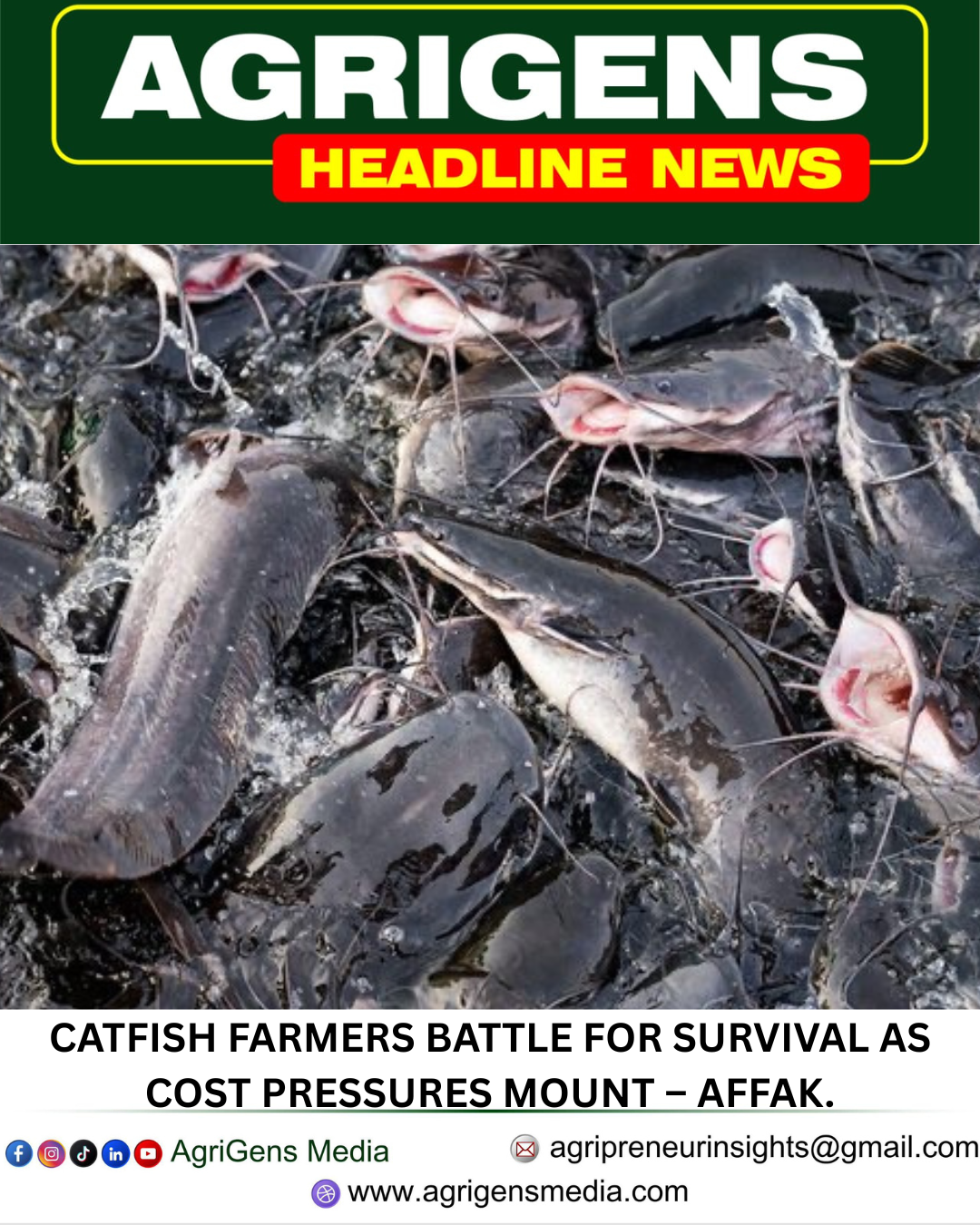
The Association of Fish Farmers in Kwara State (AFFAK) has expressed deep concern over the rising cost of fish feeds and other production inputs, warning that many catfish farmers are facing severe financial difficulties and struggling to stay in business.
The association noted that while the prices of essential production materials continue to increase steadily, the market price of catfish has remained relatively low, leaving farmers with little profit margin.
President of AFFAK, retired Gen. Tayo Olasupo, made the disclosure during a practical demonstration session organised for fish farmers under the FISH4ACP cluster upgrading programme. The training focused on pond preparation, farm planning and record keeping.
Olasupo said the persistent increase in operational costs has forced several fish farmers to abandon the business, while many others continue to operate under difficult conditions in the hope that the situation will improve.
According to him, the selling price of catfish has recorded only marginal growth over the past few years despite rising inflation and escalating production expenses. He explained that catfish sold for between N1,800 and N2,300 per kilogramme about two years ago, while the current market price still remains below N2,600 per kilogramme.
He called on both the federal and state governments to provide support for fish farmers through subsidies on fish feeds and intervention programmes aimed at reducing production costs.
The AFFAK president also appealed to feed manufacturers to collaborate with the association in making fish feeds more affordable and accessible to farmers across the state.
Olasupo further advocated the establishment of commodity boards and improved access to grants and funding opportunities through institutions such as the Bank of Agriculture and the Bank of Industry to protect farmers from exploitation and improve sustainability in the sector.
Also speaking at the event, the Director of Fisheries at the Kwara State Ministry of Agriculture and Rural Development, Nasir Akogun, identified inadequate financing for production inputs as one of the major challenges threatening the sustainability of aquaculture in the state.
Akogun described aquaculture as a critical sector capable of generating employment, strengthening food security and improving access to affordable protein for the growing population.
The training programme was organised by the Justice, Development and Peace Commission (JDPC) of the Catholic Archdiocese of Ibadan in partnership with the Food and Agriculture Organisation of the United Nations (FAO), ACP, the European Union and German Cooperation.
Representative of JDPC, Anthony Adedeji, disclosed that the training programme commenced in October last year and had reached its 24th week. He added that the demonstration session was organised to enable participants showcase the practical knowledge and skills acquired during the training.