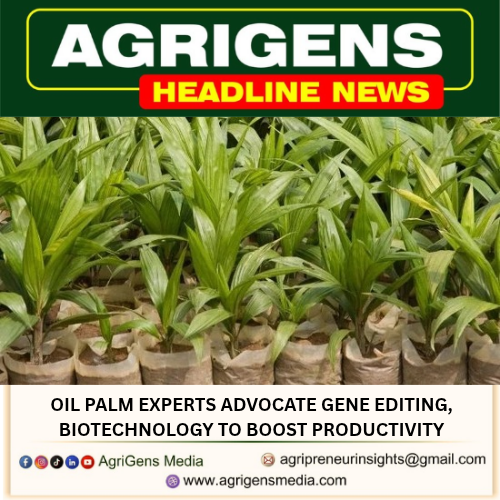
Oil palm breeding experts have called for the integration of conventional breeding, modern biotechnology and gene-editing technologies to develop high-performing planting materials, enhance productivity and strengthen the crop’s resilience to climate change.
The experts made the call at a lecture organised by the Nigerian Institute for Oil Palm Research (NIFOR) in Benin, Edo State, where they highlighted the role of emerging technologies in accelerating the development of improved oil palm varieties.
Dr Claude Bakoume, Africa Regional Representative of the International Society for Oil Palm Breeders (ISOPB), said gene editing could overcome some limitations of conventional breeding by enabling researchers to introduce specific traits into oil palm varieties.
He explained that the technology could facilitate the development of palms with improved drought tolerance, reduced height and modified fatty acid compositions for enhanced industrial applications.
Bakoume added that gene editing could significantly shorten the time needed to develop improved varieties, enabling researchers to respond more quickly to agricultural challenges, particularly those linked to climate change.
He warned that changing weather patterns and prolonged drought posed significant threats to oil palm productivity, emphasising the need to develop planting materials capable of adapting to varying environmental conditions without substantial yield losses.
The expert also stressed the importance of effective field management in breeding programmes, noting that errors during seedling distribution and transplantation could result in discrepancies in progeny numbers and compromise research outcomes.
He called for accurate labelling, systematic record keeping and proper field mapping to ensure that planting materials were correctly identified and monitored throughout breeding trials.
Also speaking, Dr Rajinder Singh of the Advanced Biotechnology and Breeding Centre of the Malaysian Palm Oil Board said integrating conventional breeding with modern biotechnology could improve crop yields and accelerate the development of high-performing varieties.
Singh explained that conventional breeding involves selecting and crossing plants with desirable characteristics, while biotechnology could complement the process by speeding up the development of improved planting materials.
He identified limited land availability as a major constraint in oil palm breeding, explaining that the crop requires extensive space for progeny trials compared with crops such as soybean.
To address the challenge, Singh encouraged collaboration between research institutions and oil palm plantations to facilitate the sharing of trial sites and other resources.
He further emphasised the need for robust experimental designs, including control groups and replication, to minimise errors and ensure the reliability of findings from breeding programmes.
Some participants described the lecture as an opportunity to gain new knowledge and insights that could help improve oil palm production.