

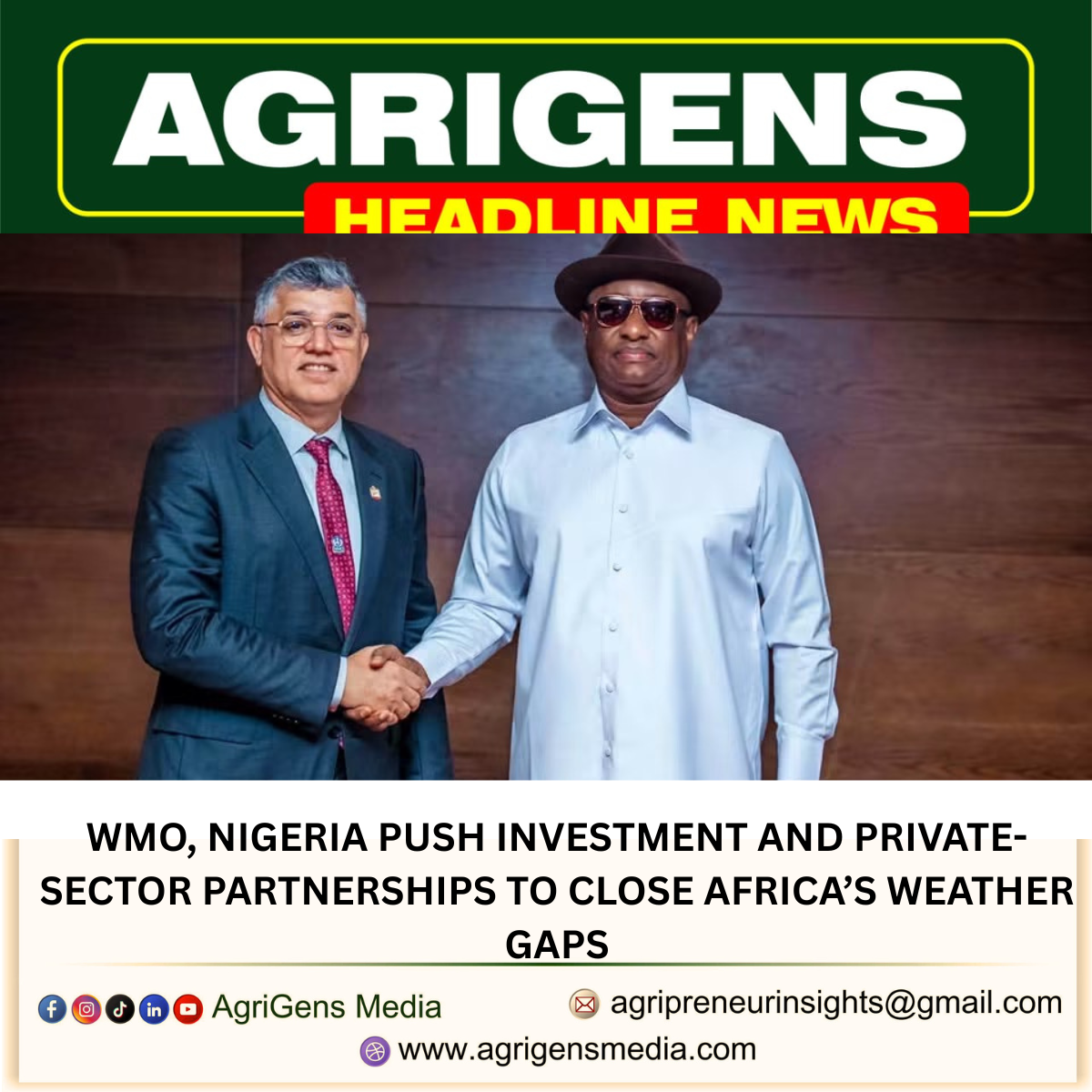
The World Meteorological Organization (WMO) and the Federal Government of Nigeria have called for increased public and private-sector investment in weather, climate and water services to address Africa’s observation gaps, strengthen early-warning systems and support sustainable economic development.
The call was made at the 2026 Annual Meeting of the Alliance for Hydromet Development, hosted in Africa for the first time at Eko Hotel & Suites in Lagos from October 13 to 15, 2026.
The meeting, themed “Partnerships, Innovation and Sustainable Investment in Weather, Water and Climate Services,” brought together governments, international financial institutions, climate-finance organisations, development partners, private-sector leaders and scientists to explore practical ways of closing hydrometeorological capacity gaps by 2030.
Speaking at the event, WMO President Dr Abdulla Ahmed Al Mandous warned that extreme weather events are intensifying while many national meteorological and hydrological services lack the infrastructure and resources required to provide life-saving warnings and support economic growth.
He highlighted the achievements of the Alliance since its launch at COP25 in Madrid in 2019, including the Country Hydromet Assessment, Hydromet Gap Reports and the Systematic Observations Financing Facility, which provides long-term support for basic weather and climate observations, particularly in Least Developed Countries.
Dr Al Mandous identified Nigeria as an example of regional leadership, noting that the country helped pilot the Country Hydromet Assessment and had progressed from receiving technical support to sharing expertise with other countries. He cited Nigeria’s role in supporting Burkina Faso as a peer reviewer under the initiative.
He also disclosed that investments in Nigeria’s weather and climate services under the ECOWAS Hydromet Initiative generate an estimated economic return of 19 to one, demonstrating the value of strengthening meteorological infrastructure.
The WMO President outlined four priorities for the period leading to 2030: increasing investment in national meteorological and hydrological services, strengthening legislation and institutional governance, expanding partnerships across critical economic sectors and promoting regional cooperation to enable African institutions to share expertise and develop locally driven solutions.
He added that the Alliance would play a central role in advancing the United Nations’ Early Warnings for All initiative, which aims to ensure that everyone on Earth is protected by multi-hazard early-warning systems.
NIGERIA REAFFIRMS COMMITMENT TO CLIMATE SERVICES
Nigeria’s Minister of Aviation and Aerospace Development, Festus Keyamo, CON, SAN, described reliable weather, water and climate information as critical national development infrastructure rather than merely a forecasting service.
He reaffirmed the Federal Government’s commitment to strengthening the institutional, technical and operational capacity of the Nigerian Meteorological Agency (NiMet), highlighting improvements in staff welfare, digital transformation, institutional reforms and implementation of the NiMet 2026–2030 Strategic Plan.
According to the minister, Nigeria is moving from reactive disaster response towards anticipatory action by using forecasts and early-warning information to reduce the impact of floods and other climate-related hazards before they occur.
He cited the Anticipatory Action Task Force on Floods, established in 2025 with support from NiMet’s Seasonal Climate Prediction, and disclosed that the National Economic Council approved ₦83.2 billion in June 2026 for interventions addressing flooding and other climate-related emergencies.
On climate finance, Keyamo said the Nigeria Climate Investment Platform was targeting $500 million to support climate-resilient infrastructure, adaptation and other priority investments.
He further disclosed that the government had approved a National Carbon Market Framework and the operationalisation of the Climate Change Fund while exploring green bonds and other financing mechanisms to mobilise resources for climate action.
The minister stressed that climate finance must translate into practical projects, noting that NiMet has an important role in identifying climate risks, assessing adaptation needs and developing credible investment opportunities.
He called for stronger private-sector participation in aviation, satellite technology, insurance, agriculture, energy, telecommunications, data analytics and financial services, arguing that government funding alone could not meet the growing demand for weather and climate services.
Citing the Hydromet Gap Report 2024, Keyamo said investments in hydrometeorological services across ECOWAS countries could generate returns of between $4 and $19 for every $1 invested, while investments in early-warning systems and climate intelligence could save up to $15 for every $1 spent.
ANOSIKE HIGHLIGHTS AFRICA’S WEATHER OBSERVATION GAPS
The Director-General and Chief Executive Officer of NiMet, Professor Charles Anosike, highlighted the scale of Africa’s weather observation challenges, stating that the continent accounts for approximately 30 per cent of the global weather-observation deficit.
He noted that Africa has only about one-eighth of the minimum weather-station density recommended by the WMO, with compliance rates across 53 countries standing at seven per cent for surface land stations and nine per cent for upper-air stations.
Professor Anosike explained that Nigeria’s large land area and limited public funding have contributed to inadequate observation infrastructure in many rural, agricultural and remote border communities.
He urged development banks, climate funds, philanthropic organisations and private investors to complement government funding by investing in radar systems, remote sensing, data analytics, high-performance computing, digital communications and data platforms that meet international standards.
The NiMet chief executive also highlighted the agency’s contributions to aviation safety, agriculture, maritime operations and disaster-risk management through aeronautical meteorological services, seasonal climate predictions, agrometeorological advisories, maritime forecasts, impact-based forecasts, flash-flood risk maps, heavy-rainfall forecasts and severe-weather alerts.
He said NiMet was moving beyond simply generating weather information towards co-producing practical services with users, including climate-smart agriculture tools, digital advisory services and weather-index insurance.
According to Anosike, meteorological information delivers its greatest value when it informs decisions, financial instruments and practical action. He added that stronger climate services would help protect lives, improve agricultural productivity, support aviation safety and reduce economic losses.
He expressed appreciation to President Bola Ahmed Tinubu and Minister Keyamo for their support towards strengthening NiMet’s workforce and institutional development.
ALLIANCE CALLS FOR SUSTAINABLE FINANCING AND INNOVATION
Speaking on behalf of WMO Secretary-General Professor Celeste Saulo, Daniel Kull highlighted persistent challenges facing national meteorological and hydrological services, including unpredictable funding, ageing infrastructure, maintenance difficulties and shortages of skilled personnel.
He identified three priorities for the Alliance’s next phase: strengthening collective action and investment, leveraging artificial intelligence and digital technologies through stronger partnerships, and making long-term sustainability central to investment decisions while preserving the authoritative public role of national meteorological and hydrological services.
Kull said the Alliance could help countries translate identified needs into credible investment priorities and project pipelines for ministries of finance and planning, climate funds, development banks, bilateral partners and philanthropic organisations.
He also highlighted the Weather, Climate and Water Intelligence Commons, a pooled financing mechanism supporting the global infrastructure for observations, data exchange, prediction, early warnings and climate services, alongside the Systematic Observations Financing Facility and the Climate Risk and Early Warning Systems initiative.
Dr Al Mandous urged participants to ensure that assessments lead to concrete investments and lasting institutional capacity, with early-warning information translated into timely action that saves lives and protects livelihoods.
The three-day meeting, which also featured presentations by representatives of the Lagos State Governor and the WMO Secretary-General, is expected to strengthen partnerships, promote innovative financing and establish a clearer investment pathway for Nigeria, Africa and other developing regions.
The discussions underscore the growing importance of reliable weather and climate information in strengthening food security, protecting critical infrastructure, improving disaster preparedness and supporting sustainable economic development.


