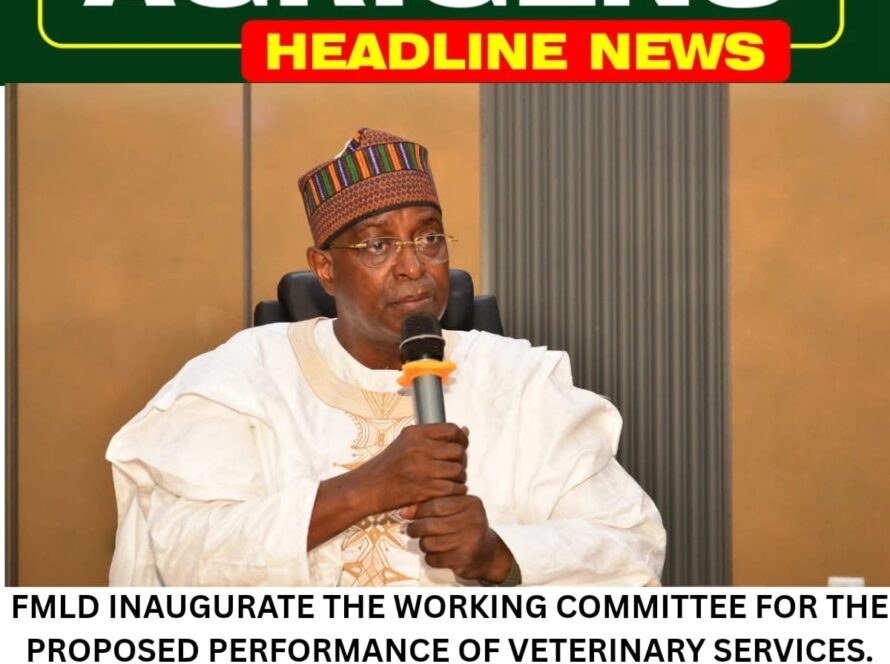
The Federal Government has urged African countries to treat agricultural extension as critical infrastructure to boost productivity, strengthen food security and meet the continent’s future food needs.
The Minister of Agriculture and Food Security, Abubakar Kyari, made the call on Wednesday, 30th of September in Abuja at the Africa Agribusiness Extension Summit 2026, organised by Extension Africa.
The summit has the theme, “Building Sustainable Agricultural Advisory Infrastructure for Africa.”
Kyari said Africa could not feed its projected 2.5 billion population by 2050 through expansion of farmland alone, stressing the need to increase productivity by improving farmers’ access to agricultural knowledge and advisory services.
“Extension must be treated as infrastructure. Roads and power lines are judged by whether they carry what the economy needs every day.
“A project can deliver advice for three seasons; infrastructure must deliver it for 30 years,” he said.
The minister urged African countries to embrace artificial intelligence (AI) in agricultural extension, but stressed that technology should complement rather than replace professional extension workers.
He also called for digital extension systems that protect farmers’ data and remain accessible through Short Message Service (SMS), Unstructured Supplementary Service Data (USSD) and voice services that can operate on basic mobile phones and weak networks.
Kyari explained that integrating farmer registries with extension services could make agricultural advice more targeted and responsive.
“A registry tells us who the farmer is, where the farm lies and what grows on it. Extension tells the farmer what to do next.
“When the two are joined, advice stops being a broadcast and becomes a prescription,” he said.
Tracing Nigeria’s agricultural extension system from community town criers and village farm teachers to the establishment of the Moore Plantation in Ibadan in 1905, Kyari said the sector had once enjoyed significant recognition but was weakened by inadequate funding.
He recalled that the World Bank-supported Agricultural Development Programmes (ADPs) once operated at a ratio of one extension agent to between 1,000 and 1,500 farm families.
According to him, declining support has left many positions vacant, with some extension agents now responsible for between 5,000 and 10,000 farmers.
“No field officer, however committed, can meaningfully serve that number through physical visits alone,” he said.
Kyari said the challenge facing Africa was no longer whether agricultural extension was necessary, but how to build systems capable of meeting future demand at scale.
“The future of extension is already in the farmer’s hand,” he said.
He recalled that in the early 2010s, the National Agricultural Extension Research and Liaison Services (NAERLS) responded to nearly 4,000 farmer enquiries by telephone.
He said the same technology could now be deployed to provide farmers with weather alerts, market information and guidance on crop diseases.
Kyari said more than 100,000 farmers across six states were receiving weekly climate advisory text messages through the Federal Department of Agricultural Extension, the Nigerian Meteorological Agency (NiMet) and private partners.
He added that the government had deployed more than 1,000 digital extension agents equipped with tablets, alongside 774 desk officers across the country’s 774 local government areas (LGAs).
According to him, the government was also rolling out a digital platform capable of communicating with farmers in Hausa, Igbo, Yoruba and Pidgin while transmitting farmers’ challenges to specialists for appropriate responses.
The minister said the government had approved a steering committee to harmonise extension initiatives involving the National Agricultural Extension Research and Liaison Services (NAERLS), National Agricultural Quarantine Service (NAQS), Agricultural Research Council of Nigeria (ARCN) and NiMet.
He said the initiative was designed to reduce fragmented and sometimes conflicting messages reaching farmers from different government agencies.
Kyari also commended states investing in agricultural extension, citing Jigawa, Kano and Oyo as examples.
He said Jigawa had recruited more than 1,500 extension agents to cover 55,000 hectares during its wheat season and approved 1,185 motorcycles to improve their mobility.
According to him, Kano recruited 1,038 extension agents in 2025, while Oyo trained 131 agents in digital farmland measurement and another 116 in improved mapping applications.
The minister urged African countries to deliberately design agricultural extension systems that reach young people and women.
He said extension services could create livelihood opportunities for young graduates without requiring them to own farmland, while women involved in planting, processing and marketing had historically received inadequate attention.
He noted that the gap contributed to the establishment of Women in Agriculture units in 1986.
“Advisory infrastructure that does not reach women directly leaves a substantial part of African agriculture without the knowledge it needs,” he said.
Kyari noted that Africa’s population had exceeded 1.5 billion in 2024 and was projected to reach 2.5 billion by 2050, while Nigeria’s population was expected to approach 400 million within the same period.
He said agriculture accounted for 34 per cent of jobs in Nigeria and more than 50 per cent across Africa, underscoring the sector’s importance to food security and livelihoods.
The minister urged participants at the summit to develop shared African standards for agricultural extension, stressing that countries could benefit from sharing knowledge and experience.
“Africa does not need to solve these challenges country by country. Knowledge can travel,” he said.