

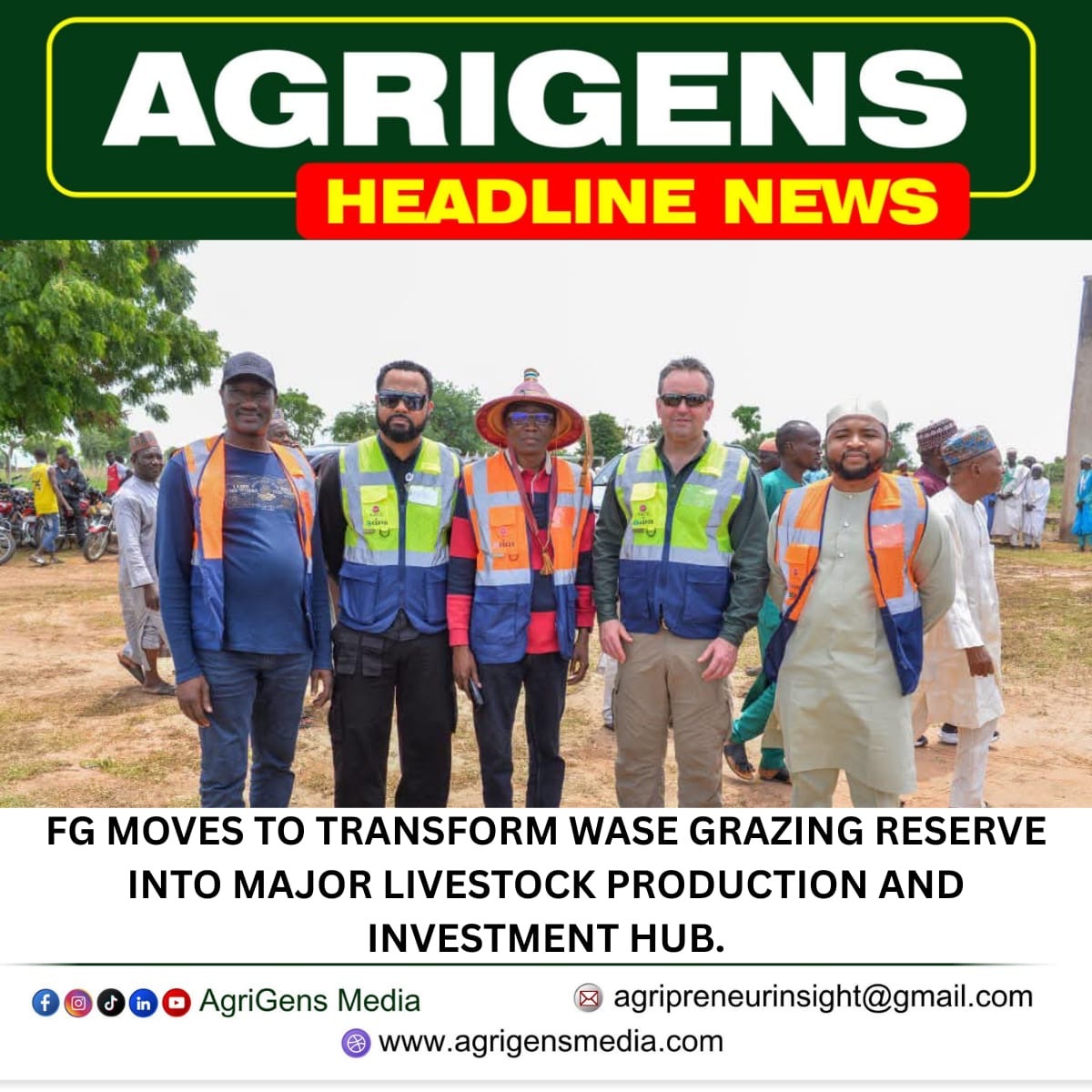
The Federal Government has reaffirmed its commitment to transforming the Wase Grazing Reserve in Plateau State into a modern livestock production hub, leveraging its over 100,000 hectares of arable land to drive investment, job creation and sustainable livestock development.
The Minister of Livestock Development, Alhaji Idi Mukhtar Maiha, stated this during an inspection visit to the reserve alongside representatives of Defence Headquarters Holdings, who have indicated interest in investing in large-scale livestock production within the facility.
According to the Minister, the Federal Ministry of Livestock Development plans to allocate about 30,000 hectares of land within the reserve to Defence Headquarters Holdings, comprising the Nigerian Army, Nigerian Air Force and Nigerian Navy, for the establishment of modern grazing and livestock production facilities.
He noted that the Ministry has engaged extensively with pastoralists, community leaders, traditional institutions and other stakeholders interested in utilizing the grazing reserve.
Maiha expressed appreciation for the support received from stakeholders in Wase Local Government Area, including traditional rulers, community representatives, political leaders and the member representing Wase Federal Constituency, Rt. Hon. Dr. Ahmed Idris Wase, for their commitment to the initiative.
The Minister said the project enjoys the full backing of President Bola Ahmed Tinubu and the Plateau State Government, providing the necessary political support for its successful implementation.
He explained that the project would focus on modern cow-calf production systems through the adoption of Artificial Insemination (AI) technology to improve livestock genetics. Selected young bulls would also be raised in feedlots for fattening before processing at modern abattoirs.
According to him, the Wase model is expected to serve as a benchmark for livestock development in neighbouring states, including Kaduna, Bauchi and Nasarawa, while encouraging the establishment of similar facilities across the country.
Maiha disclosed that a livestock enterprise of this scale could generate more than 10,000 direct and indirect jobs, describing the livestock sector as one of the fastest-growing segments of Nigeria’s economy.
He added that the Ministry is collaborating with the Plateau State Government, private investors and development partners to advance sustainable livestock development in the state.
The Minister further revealed plans to strengthen the dairy value chain through partnerships with key industry players, including Integrated Dairies Limited in Jos. He said the Ministry intends to establish solar-powered milk collection centres to improve milk aggregation, processing and marketing, while creating employment opportunities and improving rural livelihoods.
He stressed that strategic investments in livestock development offer a sustainable pathway to addressing economic and security challenges by creating jobs, increasing incomes and promoting peaceful coexistence.
During the visit, the Minister inspected pasture development sites, storage facilities and pasture-processing equipment provided through the collaboration between the Federal Ministry of Livestock Development and the Plateau State Government.
Also on the delegation was the executive management of ABIS Group, which has expressed interest in establishing feedlots to supply quality bulls to the modern abattoir currently under construction in Heipang, Plateau State.
The inspection covered proposed sites for pasture development by Defence Holdings Limited, a micro-earth dam constructed by the Federal Ministry of Water Resources for irrigated pasture production and infrastructure at one of the livestock service centres within the reserve.
Officials of the Universal Basic Education Commission (UBEC) also assessed the educational needs of communities in the area, while representatives of the Nigerian Sovereign Investment Authority (NSIA) and the Nigeria Incentive-Based Risk Sharing System for Agricultural Lending (NIRSAL) evaluated investment opportunities and strategies to support sustainable public and private sector interventions in the state.
The Minister held separate interactive sessions with stakeholders at the grazing reserve and at the palace of the Emir of Wase, emphasising the importance of stakeholder participation, adoption of improved livestock production practices and collaboration with private investors.
He assured residents of the Federal Government’s commitment to fulfilling its promises of job creation, poverty reduction, economic growth and improved security under the Renewed Hope Agenda.
As part of the visit, the Minister, alongside the National Project Coordinator of the Livestock Productivity and Resilience Support Project (L-PRES), Dr. Sanusi Abubakar, commissioned a Digital Weather Station in Wase. The facility, funded by L-PRES and managed by the Nigerian Meteorological Agency (NiMet), is designed to support climate-smart livestock production.
Maiha described the weather station as a major step toward improving livestock and pasture management through the monitoring of rainfall patterns, wind speed, soil temperature and other critical climatic factors.
He added that the facility aligns with the Ministry’s commitment to nature-based solutions and greenhouse gas mitigation in livestock production.
Speaking on behalf of the host communities, stakeholders welcomed the initiative, describing it as a transformational investment capable of stimulating economic growth, creating jobs and enhancing food security.
Earlier, the National Project Coordinator of L-PRES, Dr. Sanusi Abubakar, disclosed that Wase Grazing Reserve is one of five pilot grazing reserves selected by the Federal Government for remodelling and revitalisation.
He explained that the project includes the installation of Automatic Weather Stations in the five pilot reserves in partnership with NiMet to strengthen climate-smart livestock production.
Dr. Abubakar added that L-PRES is implementing complementary interventions, including sedentary livestock production schemes within the grazing reserves, aimed at promoting sustainable livestock development, improving resource management and enhancing the livelihoods of livestock farmers in Plateau State.

