

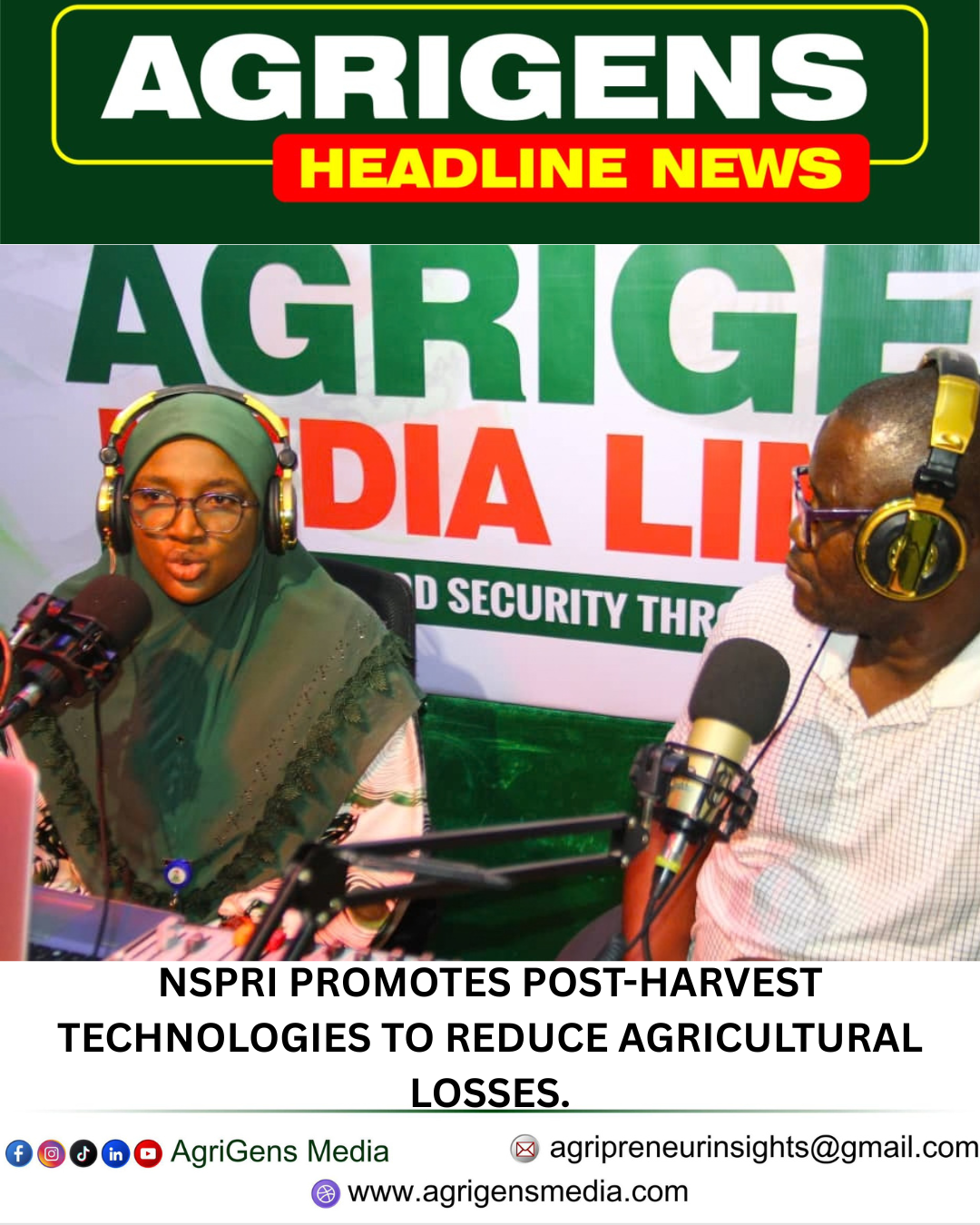
The Zonal Coordinator of the Nigerian Stored Products Research Institute (NSPRI), Ibadan Zonal Office, Dr. Aremu Mariam Bukola, has highlighted the institute’s commitment to reducing post-harvest losses through innovative storage and processing technologies for farmers across the country.
Dr. Aremu made this known while featuring as a guest on Agric-Discussion, a weekly programme on AgriGens Media, where she spoke on the theme, “Mandate and Activities of the Nigerian Stored Products Research Institute (NSPRI).”
According to her, NSPRI is mandated to conduct research and develop technologies aimed at improving the storage, preservation, processing and utilization of agricultural produce, including grains, fruits, vegetables, fish and other farm products.
She explained that the institute has developed several innovative technologies designed to reduce post-harvest losses and improve food security. Some of these technologies include the Parabolic Solar Dryer, Solar Cold Room, Stackable Plastic Crates/Baskets and Fish Smoking Kilns among others.
Dr. Aremu noted that these technologies help farmers preserve the quality of their produce, extend shelf life and increase profitability. However, she pointed out that access to some of the technologies may be challenging for individual farmers due to the high cost of installation and maintenance.
To address this challenge, she advised farmers to form clusters, cooperative societies, or commodity associations to enable them collectively access and benefit from the technologies.
“Most of these technologies are capital intensive. We encourage farmers to come together in groups or associations so they can jointly acquire and utilize them for maximum benefit,” she said.
The NSPRI Zonal Coordinator further disclosed that the institute organizes training programmes for farmers on a quarterly basis. She explained that the trainings cover various aspects of post-harvest management, including harvesting, handling, processing, storage, packaging and marketing of agricultural produce.
According to her, the themes of the training programmes vary from one quarter to another, depending on emerging challenges and the needs of farmers. She added that the trainings are offered at minimal cost to encourage commitment and participation among beneficiaries.
“People tend to value what they pay for. That is why our trainings come at a very low cost, while ensuring participants gain practical knowledge that can improve their farming businesses,” she stated.
Speaking on food safety, Dr. Aremu warned farmers about the dangers of aflatoxin contamination in grains. She explained that aflatoxins are harmful substances produced by fungi when grains are not properly dried before storage.
She stressed that aflatoxin contamination poses serious health risks to consumers and can also lead to rejection of agricultural commodities in local and international markets.
Dr. Aremu therefore urged farmers to ensure proper drying and storage of their produce to prevent fungal growth and minimize post-harvest losses.
She reiterated NSPRI’s commitment to supporting farmers with research-based solutions, capacity building and innovative technologies that will enhance agricultural productivity, improve food quality and strengthen Nigeria’s food security.
The Agric-Discussion programme continues to provide a platform for agricultural experts and stakeholders to share knowledge and practical solutions aimed at advancing the agricultural sector and improving the livelihoods of farmers across Nigeria.

