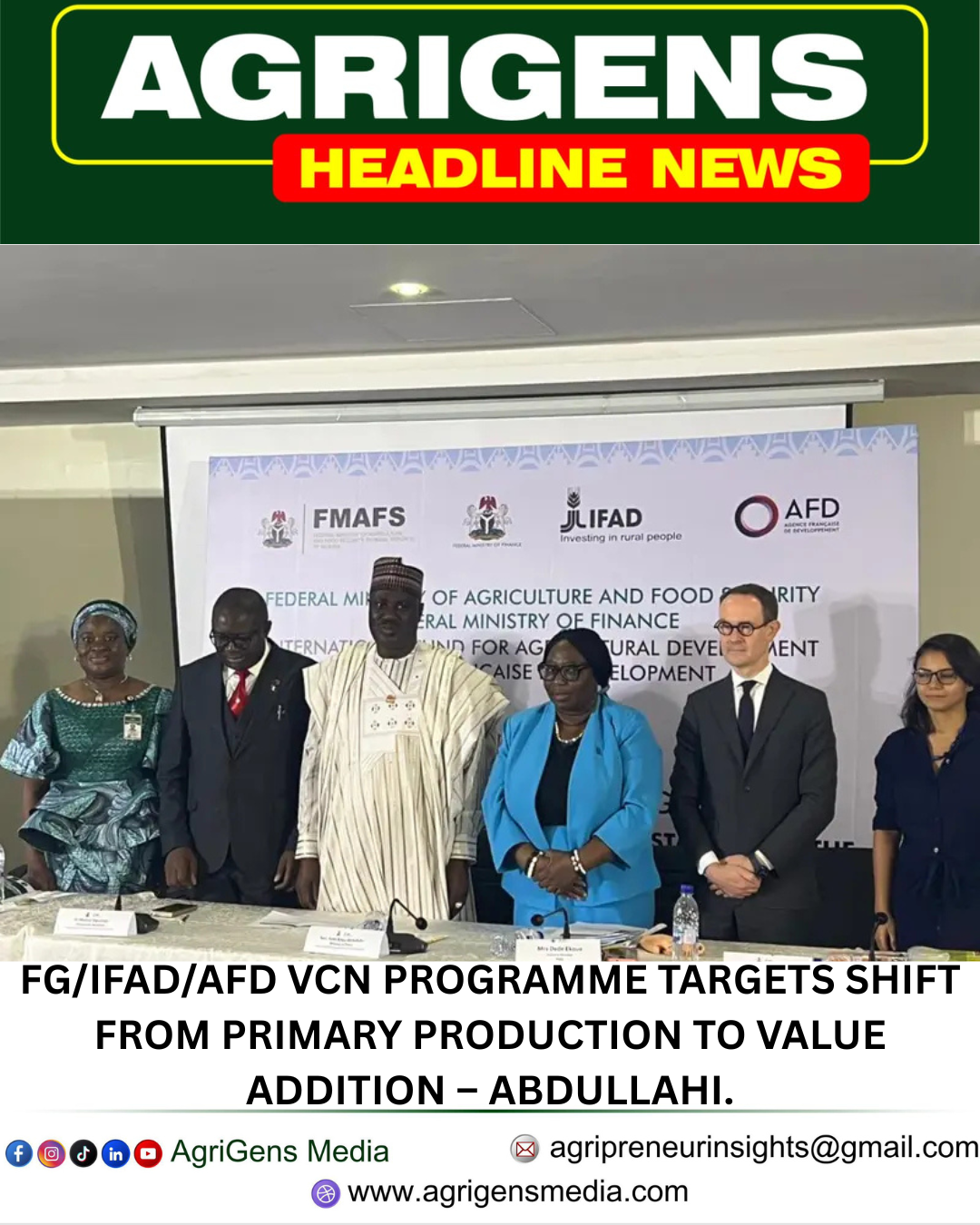
The Federal Government, in collaboration with the International Fund for Agricultural Development and the Agence Française de Développement, has reaffirmed its commitment to transforming Nigeria’s agricultural sector through the Value Chain Development Programme (VCN), with a strong focus on shifting from primary production to value addition.
The National Coordinator of the programme, Abdullahi, disclosed that the initiative is designed to enhance productivity, improve processing capacity, and increase the profitability of agricultural commodities across targeted value chains.
According to him, the programme is moving beyond traditional farming approaches to promote processing, packaging, branding, and market integration, ensuring that farmers and agribusiness operators capture more value from their produce.
He noted that a major challenge in Nigeria’s agricultural sector has been the over-reliance on raw commodity production, which limits income potential and exposes farmers to price volatility. The VCN programme aims to address this by supporting investments in agro-processing and value chain infrastructure.
The initiative focuses on key commodities such as rice, cassava, and other staple crops, providing beneficiaries with access to improved inputs, modern processing facilities, financing, and technical support.
Stakeholders emphasized that value addition is critical for enhancing export competitiveness, reducing post-harvest losses, and creating employment opportunities, particularly for youth and women.
In addition, the programme promotes public-private partnerships and collaboration with financial institutions, to ensure sustainable funding and scalability of agribusiness ventures.
Experts highlighted that strengthening value chains can significantly improve food security, rural incomes, and economic diversification, while positioning Nigeria as a competitive player in regional and global markets.
However, challenges such as infrastructure deficits, high energy costs, and limited access to finance were identified as key constraints that must be addressed for the programme to achieve its full impact.
The Federal Government and its partners reaffirmed their commitment to supporting farmers and agribusinesses through capacity building, policy support, and investment facilitation, ensuring the successful implementation of the programme.
With the VCN programme, Nigeria is taking a strategic step toward building a more resilient, value-driven, and market-oriented agricultural sector, capable of delivering sustainable growth and improved livelihoods.